
Oat stripe mosaic virus
Furovirus avenae
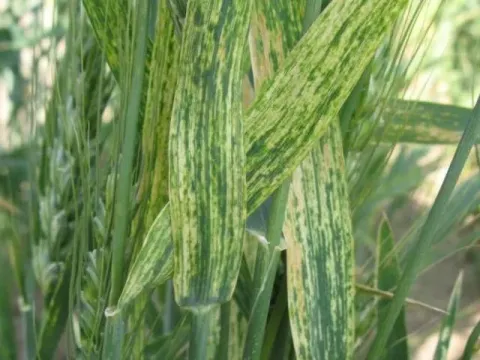
The primary symptom of the disease is the appearance of characteristic chlorotic streaks and stripes on young oat leaves, running parallel to the leaf veins.
What the section contains
Oat stripe mosaic virus
As the infection progresses, these stripes may coalesce, causing significant yellowing of the leaf blade and leading to premature tissue necrosis.
Plants infected at early growth stages show stunted development and a marked reduction in vigor compared to healthy specimens.
Infected plants typically exhibit poor tillering, shortened internodes, and a deficiency in overall biomass, altering the crop architecture.
In the reproductive phase, panicles often show severe malformation, partial sterility, or fail to emerge fully from the leaf sheath.
The disease is caused by the Oat stripe mosaic virus, which is a member of the Furovirus genus.
The viral particles are rod-shaped and contain a single-stranded RNA, characteristic of soil-borne furoviruses.
The virus is transmitted in the field by the soil-borne plasmodiophorid fungus, Polymyxa graminis, which parasitizes the roots of cereal plants.
The virus can persist within the resting spores of the fungus in the soil for many years, making crop rotation a long-term strategy rather than an immediate fix.
Transmission occurs when the root systems of young seedlings come into contact with the motile zoospores of the fungus, facilitating viral entry into plant tissues.
Epidemics are favored by cool and wet weather conditions, which are optimal for the activity and reproduction of the fungal vector, Polymyxa graminis.
Infection is most intense in low-lying areas or poorly drained fields where soil moisture levels remain high for extended periods.
Frequent spring cold snaps slow down the growth of oat plants, increasing their susceptibility to the viral infection via their root systems.
Continuous monocropping of oats or other susceptible cereal hosts leads to an accumulation of both the virus and its fungal vector in the soil.
The presence of grass weeds acting as alternative hosts creates a reservoir for the virus, promoting rapid spread across the field.
The main danger of the virus lies in its systemic nature, causing irreversible metabolic disruptions within the plant.
Reduced photosynthetic activity due to chlorosis directly correlates with decreased dry matter accumulation and impaired growth energy.
Economic damage is manifested in significant yield losses, ranging from 10% to 50%, alongside a severe reduction in grain quality and seed viability.
Infected plants display increased vulnerability to secondary fungal pathogens and environmental stressors such as drought or frost.
The resulting reduction in harvest quantity and quality renders the affected crop economically unviable for commercial grain distribution.
The primary defense strategy involves the deployment of resistant or tolerant oat varieties that limit viral accumulation in plant tissues.
Implementing a science-based crop rotation using non-host crops is crucial for reducing the infectious fungal load in the soil over time.
Strict weed management in and around the fields is essential to eliminate reservoirs of the virus and the fungal vector.
Improving field drainage and optimizing soil moisture management helps create an environment unsuitable for the survival of Polymyxa graminis zoospores.
- Maintaining adequate spatial isolation between current fields and previously infected sites.
- Applying balanced mineral fertilization to boost the plant's natural immune response.
- Monitoring fields closely to identify and destroy small infection patches before they expand.