
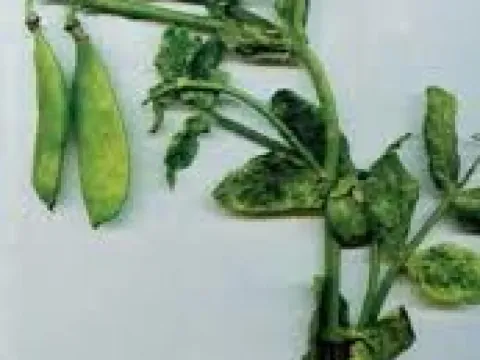
Pea mosaic virus
Carlavirus pisi
Pea mosaic virus is caused by a pathogen belonging to the Carlavirus genus. It is an obligate parasite that requires living plant tissue for its survival and replication within the host.
What the section contains
Pea mosaic virus
The virus particles are filamentous in shape. It has a broad host range, infecting various legumes, which makes the containment of the disease challenging in agricultural environments.
Transmission occurs through mechanical contact between infected and healthy plants, as well as via seeds, although seed-borne infection is not the primary mode of spreading in commercial fields.
Aphids are the primary vectors for this virus. The transmission is non-persistent, meaning the aphid acquires the virus after short feeding sessions on infected plants and transmits it immediately to healthy hosts.
The virus affects not only garden peas but also lupines, fava beans, and several wild leguminous species, which serve as crucial reservoirs for the pathogen between cropping seasons.
Initial symptoms include chlorotic spots and mottling on young leaves. As the infection progresses, a distinct mosaic pattern emerges, characterized by alternating light and dark green areas on the leaf blades.
Deformation of the leaf structure is common, often leading to crinkling, curling, or thickening of the leaves. Infected plants show stunted growth with shortened internodes, giving them a dwarfed appearance.
Flowering is significantly impaired, often resulting in flower abortion or the formation of poor-quality pods. If pods develop, they are typically small, malformed, and contain fewer, low-quality seeds.
The root system is adversely affected, leading to reduced nodule formation. This disruption hampers the plant's nitrogen-fixing capacity, ultimately limiting nutrient uptake and overall plant vigor.
In some cases, symptoms may remain latent, especially under suboptimal environmental conditions, where the virus might manifest only as mild yellowing or subtle leaf distortion.
Epidemics are most prevalent in warm, dry weather, which favors the rapid reproduction and migration of aphid populations. These weather conditions enhance the rate of viral spread across the field.
Fields located near permanent leguminous pastures or wild habitats are at high risk. These areas provide a steady source of inoculum, as the virus persists in these plants throughout the winter.
Dense plant stands facilitate the mechanical transmission of the virus through frequent physical contact between foliage. While moisture does not directly spread the virus, it impacts the activity level of the insect vectors.
Weed management is critical, as many weed species act as asymptomatic reservoirs for the virus. Neglecting weed control allows the pathogen to persist close to the crop throughout the season.
Early-season planting can sometimes increase the risk if it coincides with the spring migration of winged aphids, as the young, tender pea shoots are highly susceptible to initial infections.
Pea mosaic virus can lead to significant economic losses, reducing yields by up to 50% depending on the infection timing and severity. Early infections often result in a total failure of the affected plants.
The reduction in seed size, weight, and viability directly impacts the market value of the produce. Seeds harvested from diseased plants often show poor germination rates, perpetuating the problem in future crops.
Infected plants are physiologically weakened and become more susceptible to secondary biotic stresses, including root rots and fungal leaf spots, which complicates disease management programs.
Loss of nitrogen fixation efficiency increases the dependency on synthetic fertilizers, thereby raising the overall cost of production while simultaneously reducing the plant's ability to cope with environmental stress.
In regions where the virus is endemic, the cumulative impact over several seasons can force growers to abandon susceptible pea varieties in favor of more resistant ones or alternative rotation crops.
The most effective strategy is the use of resistant pea cultivars. Breeding programs focus on identifying and incorporating genetic resistance to minimize the impact of the virus on farm profitability.
Maintaining spatial isolation between pea fields and perennial legume sources is a vital preventive measure. A buffer zone helps reduce the influx of viruliferous aphids during the critical early growth stages.
Integrated pest management (IPM) involving systematic monitoring and insecticide applications can suppress aphid populations. Targeting the vector during its initial arrival on the field is essential.
Cultural practices, such as weed removal and strict adherence to crop rotation, play a major role in breaking the virus cycle by depriving the pathogen of its host reservoirs.
- Planting certified, virus-free seeds.
- Implementing effective spatial isolation.
- Regular scouting for aphid vectors.
- Application of systemic insecticides when necessary.
- Sanitation practices, including the removal of infected weeds and crop residues.