
Pea mosaic virus
Carlavirus pisolani
Description
Symptoms
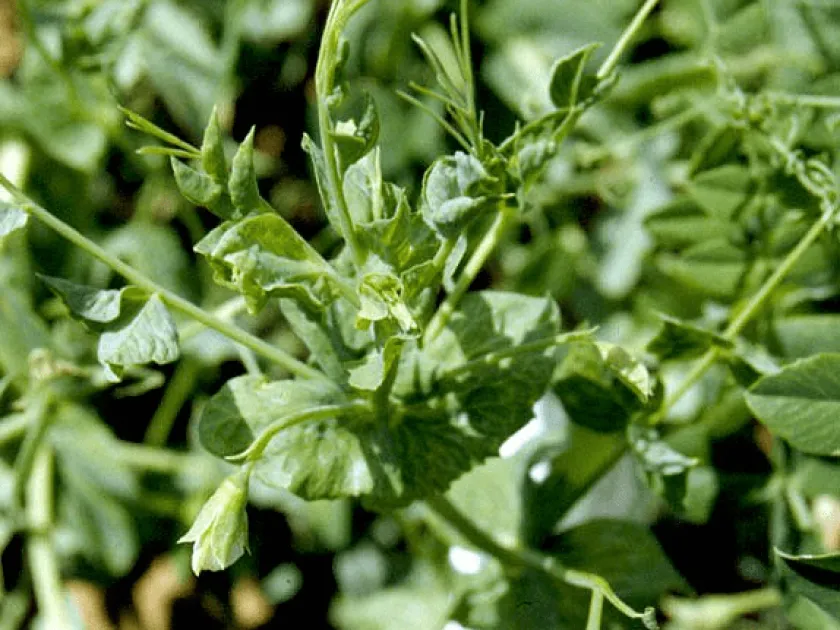
The primary symptom of infection is a characteristic mosaic pattern on the leaves. Leaf tissues show alternating patches of light green, yellow, and dark green, creating a distinct variegated appearance.
Deformation of the leaf blades is observed: they become wrinkled, twisted, and sometimes take on a thread-like form, indicating a systemic disturbance in the plant's metabolism.
The tops of infected plants often show stunted growth, shortened internodes, which gives the plant a non-characteristic, squat, or dwarfed appearance.
During the flowering period, affected specimens form fewer flowers, which often drop prematurely. Pods on infected pea plants develop as deformed, small structures with clear underdevelopment of seeds.
The root system also undergoes changes during viral infection, becoming less developed, which reduces the plant's ability to absorb essential nutrients and moisture from the soil.
Pathogen
The causative agent of the disease is the Pea mosaic virus (PMV), classified within the Carlavirus genus. This is a pathogenic virus with filamentous particles containing single-stranded RNA.
Pea mosaic virus is an obligate parasite incapable of development outside living plant cells. It persists in overwintering perennial legumes, which act as the primary reservoirs for the infection.
Vectors of the pathogen in agricultural ecosystems include various species of aphids, most commonly the pea aphid. The virus is transmitted in a non-persistent manner, allowing for rapid transmission after short feeding periods by the insect on infected plants.
Beyond insect transmission, the virus can spread mechanically, although in field conditions, this route is secondary compared to the entomological factor.
The disease affects a wide range of cultivated and wild plants in the Fabaceae family. Most susceptible species include peas, lupines, clover, vetch, fava beans, and certain types of alfalfa.
Conditions for development
The development of epiphytotics directly depends on the population density of the aphid vector in the fields. Dry and warm weather in the spring promotes rapid multiplication of pests and active migration of the virus.
The infectious background increases when infected perennial grasses, such as clover or alfalfa, are present near the fields, serving as a primary infection source for young pea seedlings.
Optimal conditions for pathogen spread include moderate air temperatures that facilitate the active movement of aphids and sufficient soil moisture to maintain host plant vegetation.
Breaching spatial isolation between perennial legume fields and new pea plantings is a key factor that triggers outbreaks of the disease during early growth stages.
Failure to control weeds near fields also creates conditions for the maintenance of virus reservoirs, ensuring a continuous chain of infection throughout the growing season.
Why it matters
The damage caused by Pea mosaic virus is expressed in a sharp decrease in the commercial quality and total grain yield. Yield losses in cases of severe infection can range from 30 to 70 percent.
The disease leads to a significant decrease in the 1000-seed weight and degradation of sowing quality, making the harvested crop unsuitable for use as high-quality seed material.
Systemic infection reduces the plant's resistance to abiotic stresses, such as drought or temporary cold snaps, which exacerbates the virus's negative impact on crop productivity.
Disruption of photosynthesis due to changes in chlorophyll-bearing tissues leads to plant depletion, making it more vulnerable to secondary fungal and bacterial infections.
Economic losses also involve the need for additional insecticide applications, aimed at reducing the number of virus vectors within the crops.
Protection
Effective management relies on a complex of measures aimed at controlling vectors and eliminating sources of primary infection within the agroecosystem.
- Spatial isolation of pea fields from perennial legume grasses (minimum of 500–1000 meters).
- Eradication of weeds capable of harboring the virus in adjacent areas.
- Use of healthy, certified seed material free from viral loads.
- Timely application of insecticides against aphids during critical crop growth stages to break the transmission chain.
- Adherence to crop rotation, avoiding the continuous cultivation of legumes in the same area.
Discussion
No discussions yet — be the first.