
Pea enation mosaic virus
Enamovirus gev
Pea enation mosaic virus (PEMV) is the type member of the genus Enamovirus. It is a plant-infecting virus with a bipartite genome consisting of single-stranded RNA molecules.
What the section contains
Pea enation mosaic virus
The virus is transmitted by aphids in a persistent-circulative manner. This means the virus must be ingested by the vector, circulate through its hemolymph, and enter the salivary glands before it can be transmitted.
Once inside the plant, the virus moves systemically throughout the vascular tissues, specifically the phloem, causing widespread cellular disruption.
PEMV often exists as a complex of two distinct viral components, which are required together for effective systemic infection and transmission by the aphid vectors.
The virus does not persist in the soil or in dead plant debris but relies on living host plants, including perennial legumes and wild clover, to overwinter.
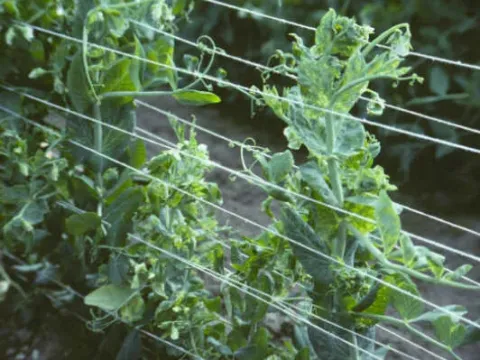
The most distinctive symptom is the formation of enations — small, ridge-like outgrowths on the underside of the leaves, typically extending along the veins.
Affected plants often show systemic chlorosis, resulting in a generalized yellowing of the foliage. Leaves may also exhibit curling, distortion, and a mosaic pattern.
Stunting is a common feature, with shortened internodes and a rosette-like growth habit, giving the plant a deformed, compact appearance.
Pods on infected plants are often significantly reduced in size, malformed, and may show irregular mottled patterns on their surfaces.
Yield loss is directly correlated with the timing of infection; early-season infection generally leads to the most severe symptoms and yield reduction.
The pea aphid (Acyrthosiphon pisum) is the primary vector responsible for the rapid spread of the virus within pea fields and across different legume crops.
Warm, favorable temperatures promote both aphid multiplication and the efficiency of viral transmission, leading to rapid disease development.
The proximity of infected perennial legume reservoirs, such as alfalfa or clover, provides a constant source of the virus, especially during the spring migration of aphids.
Dense crop stands and the presence of weed hosts facilitate the movement of aphids, creating a conducive environment for the establishment of viral epidemics.
Wind-assisted migration of winged aphids can introduce the virus into clean fields from long distances, making isolation challenging.
Pea enation mosaic virus is economically damaging because it causes substantial losses in both seed yield and forage quality in affected legumes.
Early-season infection can prevent pods from setting entirely, leading to near-total failure of the crop in heavily infested fields.
Reduced photosynthetic activity due to chlorosis and leaf distortion severely limits the plant's ability to accumulate biomass and fill the seeds.
Infected plants are physiologically stressed, making them more susceptible to secondary fungal and bacterial pathogens that further degrade crop quality.
The economic impact extends to the seed industry, as infected seeds may be undersized and exhibit poor germination rates, impacting subsequent planting seasons.
Managing the aphid population is the most effective way to limit the spread of PEMV, usually involving the application of systemic insecticides at the first sign of aphid infestation.
Implementing a spatial separation between newly sown pea fields and established perennial legume forage areas can significantly reduce the influx of virus-carrying aphids.
Early planting dates are often recommended to allow the crop to reach a stage of maturity that is less susceptible to severe damage before the peak aphid migration occurs.
Rigorous weed control is essential to eliminate alternative host plants that serve as the virus and vector reservoir during the off-season.
- Deployment of resistant pea cultivars
- Systematic crop rotation
- Integrated pest management (IPM)
- Use of clean, virus-free seeds