
Watermelon coguvirus
Coguvirus citrulli
The causative agent of the disease is the virus Coguvirus citrulli, a member of the genus Coguvirus. It is a segmented virus that significantly impacts cucurbit crops worldwide.
What the section contains
Watermelon coguvirus
This pathogen belongs to the category of plant viruses that disrupt vital physiological processes within the host tissue, leading to stunted development.
The virus is primarily transmitted by insect vectors, such as thrips, which acquire the virus while feeding on infected plant tissues and subsequently move to healthy plants.
Understanding the biology of Coguvirus citrulli is essential for developing resistance breeding programs and diagnostic protocols for commercial watermelon growers.
Researchers focus on the transmission dynamics of this virus, as identifying specific insect vectors is key to controlling its spread within agricultural landscapes.
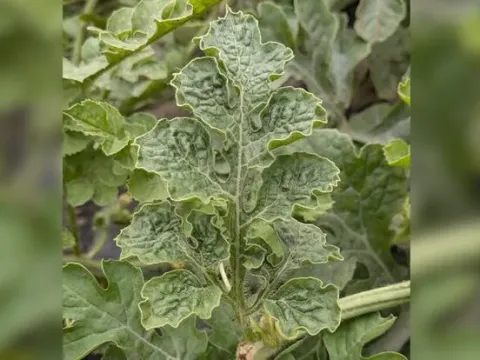
Symptoms of Watermelon coguvirus infection include systemic mosaic patterns on leaves, which may appear as chlorotic mottling or yellowing of the foliage.
Infected plants typically exhibit severe growth retardation, resulting in a reduced canopy and limited leaf surface area compared to healthy counterparts.
Fruit symptoms are particularly destructive; fruits often show deformation, uneven ripening, and surface discoloration, making them unsuitable for market.
Leaf curling and necrosis may appear in advanced stages of the infection, indicating a total systemic failure of the plant's metabolic transport systems.
Because symptoms can be easily confused with nutrient deficiencies or other viral pathogens, laboratory confirmation is often required for an accurate diagnosis.
The development of the disease is heavily dependent on the presence and activity levels of the insect vector populations throughout the growing season.
Optimal environmental conditions for the virus include warm temperatures and high humidity, which favor the proliferation of insect pests and speed up viral transmission.
Surrounding weed hosts serve as a continuous source of inoculum, allowing the virus to persist in the area even after the main crop has been harvested.
Dense planting patterns and poor ventilation in greenhouse conditions significantly increase the rate of viral spread between individual plants.
Agricultural practices that favor the survival of vectors throughout the winter months exacerbate the risk of early-season infection for new plantings.
The primary harm caused by Watermelon coguvirus is the drastic reduction in total yield quantity and the complete loss of commercial quality of the fruits.
Plants affected by this pathogen show significantly reduced sugar accumulation and compromised nutritional profiles, affecting the final taste of the watermelon.
Economic damage is further compounded by the costs of attempting to manage the disease and the loss of entire harvest batches that do not meet quality standards.
The cumulative effect of the viral infection makes the crop more susceptible to opportunistic secondary fungal or bacterial pathogens, causing further field losses.
In cases of severe early-season infection, entire fields may need to be abandoned, leading to significant financial losses for the grower.
Effective management strategies include the use of high-quality, virus-tested seeds or transplants to ensure that the initial crop start is free of the pathogen.
Integrated Pest Management (IPM) is crucial, focusing on the rigorous control of insect vectors through targeted insecticide applications and pheromone traps.
Cultural practices such as rotating crops, removing infected plants promptly, and eliminating weeds are essential components of an effective control program.
Maintaining physical barriers, such as insect-proof netting in greenhouses, can significantly minimize the risk of virus transmission from outside sources.
- Routine monitoring of insect populations during critical growth stages.
- Sanitizing farm tools to prevent mechanical transmission of the virus.
- Establishing buffer zones between new and old crop fields.
- Choosing resistant or tolerant watermelon varieties if available.