
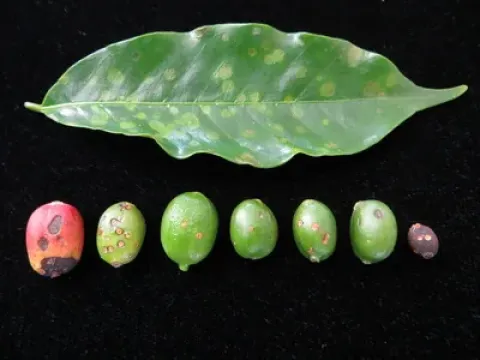
Coffee blister
Coffee blister
The causative agent of coffee blister is the fungus Taphrina coffeicola. This microscopic pathogen belongs to the Ascomycota division and is highly specialized in infecting the vegetative parts of coffee plants.
What the section contains
Coffee blister
This disease falls under the category of taphrinosis. The fungus develops within plant tissues, causing abnormal cell growth (hyperplasia and hypertrophy), which results in characteristic blistering on leaves and stems.
The pathogen survives within the perennial tissues of the plant during the dormant period, ensuring its persistence and availability for the next growing season.
Dissemination occurs through spores dispersed by wind and water droplets. New, rapidly growing leaves and shoots are particularly susceptible to primary infections.
The biology of Taphrina coffeicola is deeply integrated with the host's growth cycle, allowing it to exploit the plant's metabolic resources during periods of active vegetative development.
The primary symptom consists of convex, blister-like spots that appear on the leaf surface. These spots are typically yellow-green or reddish, depending on the severity of the infection.
Over time, these spots darken and undergo necrosis, causing the leaf tissue to curl and deform. This reduces the overall efficiency of photosynthesis significantly.
A fine, powdery layer may appear on the underside of the leaves; this is the fruiting body of the fungus, representing an active stage of spore production and transmission.
On young shoots, the infection causes swelling and twisting of the stems. These damaged areas become fragile, often leading to structural failure or breakage during windy conditions.
In cases of severe infestation, the plant suffers from premature leaf drop, leading to a thin canopy and an overall stunted appearance of the coffee tree.
High humidity and moderate temperatures are the most critical factors for the rapid development of the disease. Prolonged rainfall periods provide the ideal environment for infection.
Fog and heavy morning dew facilitate the germination of spores on leaf surfaces. Under these conditions, the incubation period is significantly shortened, leading to explosive spread.
Densely planted coffee trees limit airflow within the canopy, creating a micro-environment with high humidity levels that are highly favorable for Taphrina coffeicola proliferation.
Improper fertilization practices, especially high nitrogen input, promote soft and succulent tissue growth, which is much more vulnerable to penetration by fungal hyphae.
The general health and physiological status of the coffee tree determine its susceptibility; nutrient-stressed plants have lower resistance and succumb to infection more rapidly.
The major impact of coffee blister is the loss of functional leaf area, which decreases photosynthetic output and exhausts the plant's stored nutrients.
Yield loss is a significant consequence, as affected trees struggle to support fruit development, leading to smaller, lower-quality beans or total berry loss.
Premature abscission of blossoms and berries directly translates into substantial economic losses for coffee producers, reducing the total annual output of the plantation.
The structural degradation of shoots and branches necessitates intensive pruning and sanitation work, which increases labor costs and complicates plantation management.
In the long run, chronic infestation weakens the tree's immune system, making it more susceptible to secondary fungal and bacterial diseases that can threaten its lifespan.
The cornerstone of management is cultural practice: regular pruning is essential to improve airflow through the canopy, effectively lowering local humidity levels.
Sanitation is equally critical; removing and destroying infected plant debris helps reduce the primary inoculum load and limits the spread of spores to healthy tissue.
The application of copper-based fungicides serves as a protective measure when applied prior to the start of the wet season or when symptoms are first identified.
Balanced plant nutrition, particularly ensuring adequate potassium and phosphorus levels, strengthens cellular walls and enhances the natural resistance of the coffee tree.
The implementation of resistant varieties is the most sustainable approach, as it reduces the dependence on chemical intervention and provides a stable defense against the pathogen.