
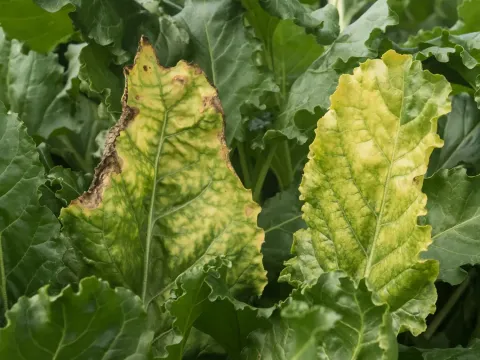
Beet yellows
Closterovirus flavibetae
The primary symptom of beet yellows is chlorosis, starting from the leaf margins and advancing inward, while the leaf veins remain green. Infected leaves typically become thickened, brittle, and snap easily when handled.
What the section contains
Beet yellows
Symptoms usually manifest first on the older, lower leaves of the plant. Over time, the chlorosis progresses upward, affecting the entire canopy and causing a distinct yellow discoloration that characterizes the disease.
Leaves often curl downward, and their surfaces may become sticky due to honeydew secreted by aphids, which subsequently promotes the growth of sooty mold. The overall appearance of the plant is stunted and unthrifty.
Root development is severely hampered, resulting in smaller, lighter, and lower-quality beet roots. Visually, infected plants stand out from the rest of the field due to their stunted growth and yellow-green color.
The severity of symptoms often correlates with the age of the crop at the time of infection. Plants infected early in the season show more dramatic stunting and significant yield reductions compared to late-season infections.
The causative agent is the Beet yellows virus (BYV), a member of the Closteroviridae family. This virus is a filamentous, phloem-limited plant pathogen that disrupts the plant's vascular system.
The virus acts as an obligate parasite, requiring a living host for survival. It persists between seasons in various weed hosts, such as wild beet and various members of the Chenopodiaceae family, as well as in regrowth from previous harvests.
Transmission occurs primarily through aphid vectors, with the green peach aphid (Myzus persicae) being the most efficient carrier. Aphids acquire the virus by feeding on infected phloem tissues and can transmit it to healthy plants shortly after.
The virus is semi-persistent within the aphid's body, meaning it can be carried for several hours or days, allowing the insect to spread the disease across large distances within a field or between adjacent areas.
Once inside the plant, the virus replicates and causes physiological changes that impede the translocation of photosynthates from leaves to roots. This blockage leads to the systemic symptoms observed throughout the plant.
The spread of beet yellows is heavily influenced by the population dynamics of aphid vectors. Warm, dry springs and summers are highly conducive to rapid aphid reproduction and migration into beet fields.
The risk of infection increases significantly during the canopy closure phase, as the favorable microclimate inside the dense foliage encourages aphid feeding and colonization of the crop.
Fields located near weed-infested areas or overwintering sites for aphids are at a higher risk of early infection. The presence of these reservoirs ensures a continuous supply of the virus throughout the growing season.
Inadequate crop rotation and the failure to remove crop residues allow the virus to persist in the local environment. High inoculum levels at the start of the season can lead to severe field-wide epidemics.
Plant stress, including drought or nutrient deficiencies, can exacerbate the impact of the virus. Stressed plants are often less capable of compensating for the metabolic disturbances caused by the infection.
The economic impact of beet yellows is primarily due to reduced root weight and lower sugar content. Infected sugar beets show significantly lower sucrose levels, making them less valuable for industrial sugar extraction.
In addition to sugar losses, the juice purity is often impaired, which increases the complexity and cost of processing at sugar refineries. Farmers may face substantial financial losses as a result of reduced quality grades.
Plants infected with the virus are more susceptible to secondary infections, such as fungal root rots and leaf spot diseases. This further reduces the storage life of the roots if they are harvested late.
In seed-producing crops, the virus leads to lower seed yield and inferior seed quality, impacting the supply of viable planting material. This creates long-term challenges for the entire sugar beet industry.
In severe cases, entire fields may suffer from drastic yield reductions, rendering the harvest commercially non-viable. Proactive management is essential to maintain the profitability of sugar beet cultivation.
Effective control relies heavily on managing aphid vectors. The application of systemic insecticides, especially during the early stages of crop development, is critical to preventing the initial spread of the virus.
Integrated pest management includes strict sanitation practices, such as the removal of volunteer beet plants and weed hosts that could serve as virus reservoirs during the off-season.
Spatial isolation of new beet fields from established infected areas or overwintering weed reservoirs helps in reducing the influx of virus-carrying aphids.
Breeding for resistance or tolerance to the Beet yellows virus is the most sustainable long-term solution. Planting resistant hybrids can significantly reduce the severity of symptoms and protect against major yield losses.
- Monitor aphid populations using yellow sticky traps.
- Practice crop rotation to break the virus infection cycle.
- Ensure uniform plant stands to manage the field microclimate.
- Use seed treatments that provide early-season protection against sucking insects.