
Begomo leaf curl virus
Begomovirus sidaboliviaensecundi
Description
Symptoms
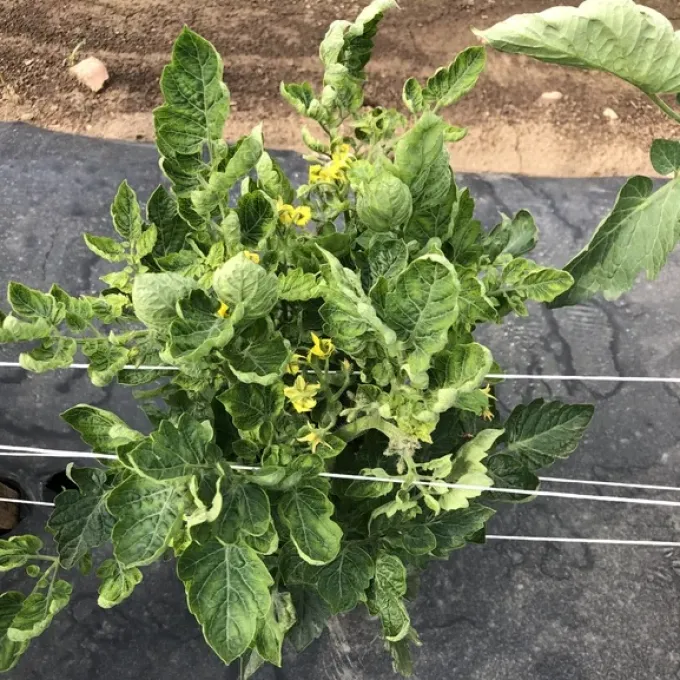
The most prominent symptom is the curling of leaf margins, often accompanied by thickening and a leathery texture of the foliage.
Affected plants exhibit severe stunting and chlorosis, which manifests as yellowing or a distinct mosaic pattern on younger leaves.
There is a noticeable reduction in internode length, giving the plant a compact, bush-like appearance due to excessive lateral branching.
Floral development is heavily impacted, frequently leading to blossom drop or the production of malformed, unmarketable fruits.
In advanced stages, the entire plant architecture becomes disorganized, significantly reducing the photosynthetic surface area.
Pathogen
The causal agent of this disease is Begomovirus sidaboliviaensecundi, a member of the Geminiviridae family characterized by a bipartite circular single-stranded DNA genome.
This virus is transmitted in a persistent, circulative, non-propagative manner exclusively by whiteflies, specifically Bemisia tabaci.
Once injected into the phloem by the insect vector, the virus replicates within the host plant cell nuclei, hijacking the cellular machinery for its own synthesis.
The viral proteins interact with the host's regulatory systems, fundamentally altering plant metabolism and inhibiting proper nutrient translocation.
The virus cannot be transmitted mechanically through sap or seeds, making the control of insect populations the primary biological barrier to its spread.
Conditions for development
Development and dissemination are strictly tied to the abundance of whitefly populations, which serve as the obligate vector for the virus.
Warm and arid climates significantly accelerate the life cycle of the whitefly, thereby increasing the rate of viral spread within the field.
Alternative weed hosts serve as year-round reservoirs for both the virus and the insect vectors, facilitating early-season transmission to commercial crops.
High-density planting and poor field hygiene provide ideal microclimatic conditions for rapid secondary spread of the virus.
In greenhouses, inadequate screening and the lack of sanitation allow the whitefly population to build up rapidly, causing localized epidemics.
Why it matters
Begomo leaf curl virus causes substantial economic losses by drastically reducing both the quality and quantity of agricultural yields.
Total crop failure can occur if the infection happens at an early growth stage, forcing producers to abandon or replant affected fields.
The aesthetic and physical deterioration of the produce makes it entirely unsuitable for commercial sale, leading to direct financial loss.
Increased susceptibility to secondary stressors and other phytopathogens often exacerbates the damage caused by the primary viral infection.
Management costs skyrocket due to the need for intensive insecticide regimes and increased labor for roguing and field maintenance.
Protection
Integrated Pest Management (IPM) is essential, starting with strict control of whitefly populations using systemic insecticides or insect growth regulators.
Implementation of physical barriers, such as insect-proof netting in greenhouses, is highly effective in preventing the initial entry of the vector.
Sanitation practices, including the eradication of host weeds in and around the farm perimeter, are critical to reducing inoculum sources.
The use of resistant or tolerant crop varieties provides the most sustainable defense against the virus and its effects on harvest.
Strategic scheduling of planting dates to avoid peaks in whitefly migration can significantly reduce the incidence of primary infection in the field.
Discussion
No discussions yet — be the first.