
Beet yellows virus
Closterovirus nanobetae
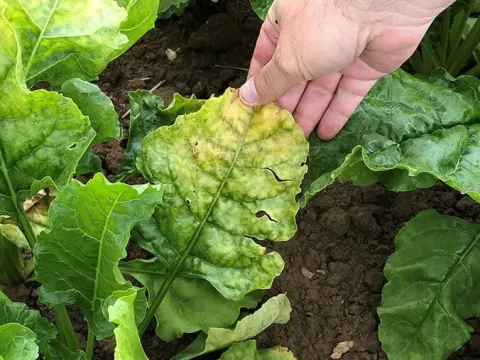
The primary symptom of the disease is the yellowing (chlorosis) of the older and middle leaves within the rosette, while the leaf veins often remain green.
What the section contains
Beet yellows virus
Affected leaves become brittle, thick, and leathery in texture. In severe cases, the margins of the leaves may roll downward, giving the plant a stunted appearance.
As the disease progresses, the chlorosis covers the entire rosette, often leading to premature leaf senescence and death. Growth of the taproot is significantly hampered.
Visual symptoms can be easily confused with nutrient deficiencies, such as nitrogen or magnesium shortage, or with pest-related damage in the root zone.
Definitive identification requires specific laboratory diagnostic procedures like ELISA or RT-PCR to distinguish it from other viral or fungal diseases.
The causal agent is the Beet yellows virus (BYV), belonging to the genus Closterovirus. It consists of long, flexuous, thread-like particles containing ssRNA.
The virus is primarily transmitted by aphids, most notably the green peach aphid (Myzus persicae) and the black bean aphid (Aphis fabae).
Transmission is semi-persistent, meaning the aphid can acquire and transmit the virus after short feeding periods on an infected plant, usually within minutes to hours.
The virus is not soil-borne, does not spread through seeds, and is rarely transmitted through mechanical contact or field operations like hoeing.
The virus replicates in the phloem tissue of the host, which directly impacts the plant's ability to transport photoassimilates to the root.
The spread of the disease is highly correlated with the migration patterns and population density of aphid vectors in the environment.
Warm, humid springs create ideal conditions for rapid aphid reproduction, leading to early infestation of sugar beet fields.
The presence of overwintering reservoir hosts, such as wild beet and various weeds in the Amaranthaceae family, ensures the virus survives through the winter.
Dry weather conditions can sometimes force aphids to migrate from drying pastures or weeds into irrigated sugar beet crops, increasing infection rates.
Temperature fluctuations and prevailing wind directions play a major role in the distance and speed at which viruliferous aphids spread across the fields.
The main damage caused by BYV is a substantial reduction in the photosynthetic capacity of the plants, which limits sugar accumulation in the roots.
Infected crops can suffer yield losses ranging from 20% to 50%, depending on the timing of the infection and the severity of the aphid pressure.
The quality of the sugar beet is negatively impacted, specifically the sucrose content, which decreases the economic value and industrial processability.
Infected plants are inherently weaker and more susceptible to secondary pathogens, particularly leaf spot diseases like Cercospora beticola.
In seed-producing fields, the virus leads to poor root quality and decreased seed viability, which can reduce the success of subsequent planting seasons.
The core of the control strategy is the integrated management of aphid populations to prevent the spread of the virus during the early vegetative phase.
Spatial isolation is a key preventive measure, keeping new sugar beet fields away from old seed crops or fields with high overwintering weed populations.
Effective weed control is essential, as many common weeds serve as symptomless reservoirs for the virus throughout the growing season.
- Application of systemic insecticides upon the detection of the first aphids.
- Monitoring aphid migration using yellow sticky traps in the field.
- Eliminating volunteer sugar beets that emerge after harvest.
- Selecting tolerant or resistant cultivars if available in the specific region.
A successful approach relies on combining cultural practices with targeted chemical interventions to protect the crop during critical growth stages.