
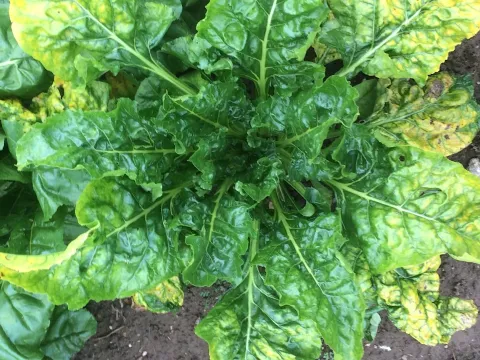
Beet yellows virus
Polerovirus bchv
Beet yellows virus (BChV) belongs to the genus Polerovirus. It is a positive-sense single-stranded RNA virus that is restricted to the phloem tissue of the host plant, disrupting the translocation of essential nutrients.
What the section contains
Beet yellows virus
The virus is not mechanically transmissible in the field, meaning it cannot spread through sap, contaminated tools, or seed. Transmission is strictly biological, relying entirely on aphid vectors to move from infected to healthy plants.
The peach-potato aphid (Myzus persicae) is the most efficient and primary vector of the virus. BChV exhibits a persistent, circulative mode of transmission, where the aphid acquires the virus after feeding on infected phloem and remains infectious for the remainder of its lifespan.
The host range includes various beet types, such as sugar beet, fodder beet, and table beet. Additionally, numerous weed species, particularly within the Chenopodiaceae family, act as crucial reservoirs during winter months.
The virus specializes in targeting the plant's vascular system. Its ability to persist in diverse hosts makes it a difficult pathogen to eradicate once it becomes established in a local agricultural landscape.
Symptoms typically start on older leaves, appearing as interveinal chlorosis. As the disease progresses, the chlorotic areas expand, giving the leaves a distinct yellowing while the leaf veins remain green.
Affected leaves become thickened, brittle, and leathery to the touch. In advanced stages, leaf margins may roll downward, giving the entire leaf rosette an abnormal, stunted, and distorted appearance.
Unlike nutrient deficiencies, the yellowing caused by BChV is characterized by its persistence and the specific, progressive nature of the discoloration starting from older leaves and moving upward to the center.
The reduction in photosynthetic capacity leads to stunted plant growth. In severe cases, the affected foliage may become necrotic or wither prematurely, severely weakening the entire plant's health.
The root system remains mostly unaffected in appearance, but its biomass development is significantly restricted. Because the virus limits the transport of sugars, root growth is severely compromised compared to healthy plants.
The spread of Beet yellows virus is dictated by the population dynamics of its aphid vectors. Warm, dry spring conditions are highly conducive to the rapid colonization and migration of winged aphid forms.
Primary infection often occurs when aphids migrate from overwintering weed hosts to young sugar beet seedlings. If the timing of aphid migration aligns with the early growth stages of the beet, the risk of a widespread outbreak is extremely high.
Environmental factors that favor high aphid reproduction rates directly correlate with increased virus pressure. Sustained high temperatures during the growing season can accelerate the viral infection cycle.
Poor spatial isolation between new beet fields and old sugar beet or seed crops provides a continuous bridge for aphids to carry the virus into fresh, susceptible plantings.
Agricultural practices that promote high plant density under moisture stress can exacerbate the impact of the virus, as plants already stressed by the environment are more susceptible to aphid colonisation.
The economic impact of BChV is substantial, primarily due to drastic losses in root yield, which can exceed 30% in cases of early-season infection. The virus essentially halts the plant's ability to store carbohydrates in the taproot.
Sugar content is significantly reduced, often by 1% to 3%, which causes a direct drop in quality. Sugar refineries face challenges in processing low-quality beets, leading to reduced efficiency and value for the producer.
The presence of the virus alters the chemical composition of the root, increasing levels of impurities. This complicates the juice purification process in sugar manufacturing plants, raising operational costs.
Infected crops are more prone to secondary infections by root rot pathogens. The compromised physiological state of the plants makes them weaker, leading to increased storage losses if harvested beets are stored for extended periods.
Harvesting becomes more difficult due to the degraded state of the foliage. Mechanized harvesters may struggle with brittle, dead leaves, and the reduced quality of the crop shortens the window for safe storage.
Integrated Pest Management (IPM) focusing on the vector is the primary line of defense. The use of systemic insecticides to control aphid populations in the early stages of crop development is essential to minimize virus transmission.
Cultural control measures, such as the removal of reservoir weeds in surrounding fields and ditch banks, are vital to reduce the initial source of the virus. Maintaining clean fields limits the aphid's ability to acquire the pathogen.
Establishing spatial isolation between current-year sugar beet fields and those where the crop was grown previously or where seed beets are present is critical for breaking the transmission cycle.
Planting resistant or tolerant cultivars is the most sustainable approach to managing the virus. Modern breeding efforts have successfully developed hybrids that can maintain decent yields even in the presence of the virus.
Early sowing can help plants pass the most vulnerable growth stages before the peak aphid migration period. Proper fertilization and irrigation improve plant vigor, enabling them to better tolerate the viral infection.