
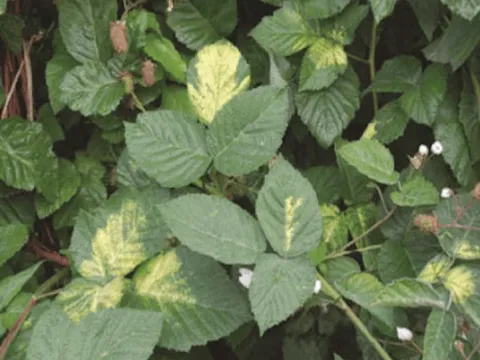
Blackberry mosaic virus
Emaravirus rubi
The causative agent of this disease is Emaravirus rubi, a viral pathogen that specifically affects Rubus species, including blackberries. The virus is a systemic pathogen, meaning it spreads throughout the entire vascular system of the host plant.
What the section contains
Blackberry mosaic virus
The primary vector for the transmission of Emaravirus rubi is the dryberry mite, Phyllocoptes gracilis. As these microscopic mites feed on infected plant tissues, they acquire the virus and subsequently transmit it to healthy plants.
Because the virus is systemic and persistent, it is efficiently transmitted through vegetative propagation. This makes infected rootstocks and cuttings the most common way for the disease to spread to new locations.
The virus replicates within the phloem tissues of the blackberry plant. Once infected, the plant remains a reservoir for the virus for the rest of its life cycle, as there are no known therapeutic cures.
The biological nature of the virus makes it highly specialized, and it does not typically infect unrelated plant species, limiting its impact to blackberry and sometimes raspberry crops.
The hallmark of blackberry mosaic is the distinctive pattern of light green to yellow spots on the leaves. These mosaic patches often appear between the veins, creating a mottled appearance.
As the infection progresses, leaves may become wrinkled, puckered, or asymmetrical. This distortion hinders the plant's photosynthetic efficiency, which directly impacts the vigor of the blackberry canes.
Infected plants exhibit a noticeable reduction in growth rate. Canes may become stunted, with shorter internodes compared to healthy plants, leading to a diminished physical structure of the bush.
Fruit production is severely affected. Berries on infected bushes are often small, crumbly, or fail to ripen uniformly, making them poor in quality and unsuitable for the commercial market.
- Mottled mosaic patterns on leaves.
- Distorted, crinkled, or curled leaf tissues.
- Stunted shoot and cane growth.
- Reduced fruit yield and poor berry quality.
- General decline in plant vigor over several seasons.
The spread of the virus is directly correlated with the population dynamics of the dryberry mite. Warm, humid conditions favor the rapid reproduction and movement of these mites between plants.
Proximity to wild blackberry thickets or abandoned plantings acts as a significant risk factor. These wild areas often harbor both the virus and the mite vectors, acting as a constant source of infection for managed fields.
High-density plantings where canes interweave facilitate easier movement for the mite vectors, thereby accelerating the rate at which the virus spreads through a single field.
Agricultural practices that promote succulent growth, such as excessive nitrogen fertilization, can make plants more susceptible to mite feeding, potentially increasing the viral load within the tissue.
The movement of plant material across regions without appropriate phytosanitary oversight is the most critical environmental condition contributing to the global spread of this mosaic disease.
The primary harm caused by Blackberry mosaic virus is the permanent loss of plant productivity. Since the infection is systemic and incurable, infected bushes become economic liabilities.
Over time, the cumulative stress of the viral infection reduces the plant's ability to survive winter or withstand other secondary stressors like drought or fungal pathogens.
Commercial growers suffer significant financial losses due to lower fruit quality and the necessity of prematurely removing and replacing entire blocks of the plantation.
The disease undermines the long-term sustainability of the blackberry enterprise, as replanting infected fields requires substantial capital investment and time to restore full production capacity.
In cases of severe outbreaks, the entire production quality of a farm can be downgraded, impacting market reputation and profitability for several years.
The most important control strategy is the use of certified virus-free nursery stock. Establishing new plantings with healthy, tested plants is the only effective way to prevent initial infection.
Rigorous management of the mite vector is essential. Regular applications of acaricides, timed to coincide with the mite's life cycle and peak activity, help to limit the transmission of the virus.
Sanitation practices, including the immediate removal and destruction of any plant showing symptoms, are critical to reducing the reservoir of infection within a commercial planting.
Maintaining a clean buffer zone around the blackberry field by eliminating nearby wild Rubus species reduces the likelihood of mite-mediated viral introduction.
Regular scouting and monitoring programs are vital to identify and isolate infected areas before the virus can be disseminated further by mite vectors or during pruning operations.