
Papaya leaf curl virus
Begomovirus papayae
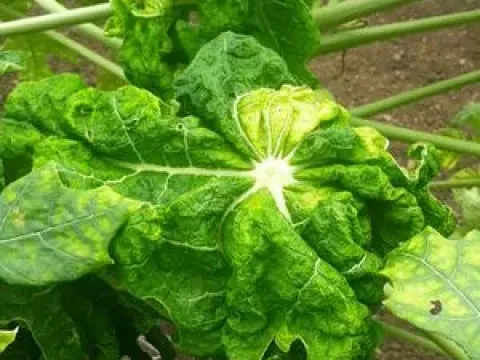
The most prominent symptom of this viral infection is the severe curling and crinkling of the apical leaves. The leaves become significantly reduced in size and lose their normal shape.
What the section contains
Papaya leaf curl virus
Internodal shortening is a characteristic sign, causing the plant to appear stunted and bushy. The apex develops a dense cluster of deformed leaves, which is why the disease is commonly known as leaf curl.
Chlorotic mosaic symptoms, characterized by yellow and light green mottled patches, often appear on the foliage. The veins may become thickened and translucent as the virus disrupts normal development.
Flowering is usually severely inhibited or completely arrested in infected plants. Even if fruits are produced, they are typically small, malformed, and lack the flavor and quality expected for market.
As the infection progresses, the plant exhibits systemic decline, growth stops completely, and in severe cases, the plant may die, leading to significant yield loss.
The causative agent is a virus belonging to the genus Begomovirus, within the family Geminiviridae. These viruses are characterized by a single-stranded circular DNA genome.
The whitefly species Bemisia tabaci acts as the primary vector for the transmission of this virus. The insect acquires the virus while feeding on the phloem of infected plants.
Once the whitefly acquires the virus, it remains a carrier for the rest of its life. The virus is transmitted to healthy plants when the whitefly feeds again, introducing the pathogen into the plant's vascular system.
There is no known mechanical transmission via sap or pruning tools, as the virus requires the specific biological interaction provided by the whitefly vector to successfully infect new tissues.
The virus exhibits significant genetic variation, which facilitates its adaptation to different environmental conditions and increases the challenge of developing fully resistant papaya cultivars.
The development of the disease is heavily dependent on the population density of the whitefly vector. Warm, dry weather conditions are ideal for rapid whitefly multiplication and high migration rates.
Alternative hosts, including various weeds growing near or within the plantation, serve as reservoirs for the virus and the whitefly, allowing the pathogen to persist between growing seasons.
Large-scale monoculture of papaya provides a continuous supply of host plants, which facilitates the rapid spread of the virus once the initial inoculum is introduced into the field.
The migration of whiteflies via wind currents allows the virus to spread across vast areas, making it difficult for individual farmers to prevent entry if neighboring areas are already infected.
Inadequate nursery management and the distribution of infected seedlings are major factors contributing to the establishment of the disease in previously disease-free regions.
Papaya leaf curl virus represents a major limiting factor for papaya production, capable of causing total crop failure in heavily infested orchards.
The economic impact is substantial due to the direct loss of fruit production and the high cost of intensive pest management strategies required to suppress whitefly populations.
Secondary consequences include the loss of labor investment and the high cost of orchard replanting, as recovery of infected mature plants is not possible under field conditions.
Farmers often face reduced marketability, as the deformed fruits produced by the infected trees do not meet quality standards for export or domestic sale.
The presence of the virus significantly limits the choice of cultivars available for planting, as many high-yielding varieties are often highly susceptible to the infection.
Effective management focuses on disrupting the disease cycle primarily by controlling the whitefly vector and minimizing sources of inoculum.
- Regular monitoring of whitefly populations using yellow sticky cards to detect early infestations.
- Application of systemic insecticides to reduce vector populations in the early stages of crop development.
- Strict rogueing of infected plants, which must be removed and destroyed to prevent further transmission.
- Sanitation practices, including the removal of weeds that act as reservoir hosts for the virus and whitefly.
- Utilizing physical barriers like fine-mesh netting for young plants to prevent whitefly contact.
The use of disease-free, certified seedlings from protected nurseries is the most critical preventative measure to ensure long-term plantation health.
Implementing integrated pest management (IPM) programs, which combine chemical, biological, and cultural practices, is essential for sustainable control of this viral threat.