
Description
Symptoms
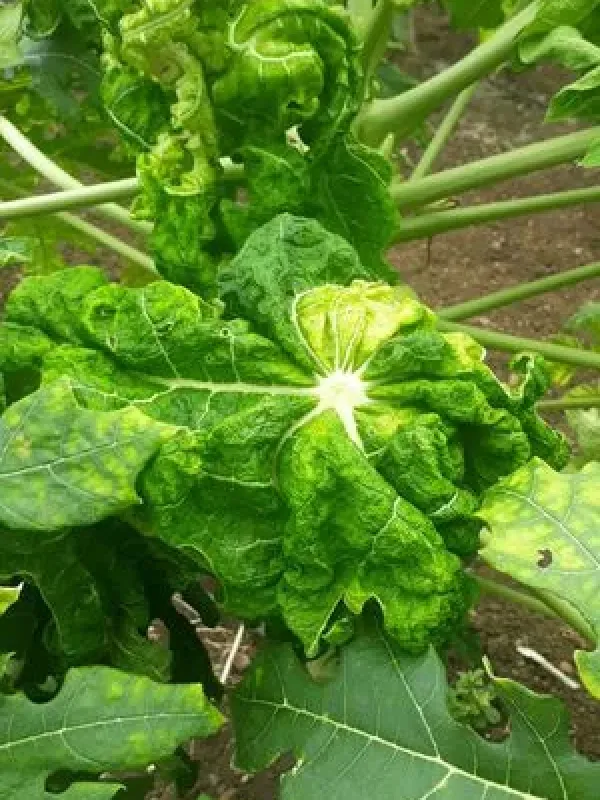
The primary symptom of papaya leaf distortion is the severe deformation of leaf blades. Leaves become narrow, elongated, and fern-like, which is why the condition is commonly termed shoestring or leaf distortion.
Early-stage infections are characterized by a distinct chlorotic mottling on younger leaves. As the disease progresses, the leaves curl and shrink, significantly reducing the plant's surface area for photosynthesis.
Infected plants exhibit stunted growth and shortened internodes. The foliage appears thin and sparse, making diseased specimens easily distinguishable from healthy plants within the field.
The fruits frequently display characteristic ringspot patterns, which may appear as circular, water-soaked spots. Severe infections lead to misshapen fruits with poor texture and significantly reduced market value.
In advanced stages, the apex of the plant may become severely deformed or necrotic, leading to a complete cessation of fruit production and the eventual decline of the entire plant.
Pathogen
The causal agent of this disease is the Papaya ringspot virus (PRSV), a member of the Potyviridae family. This virus is one of the most destructive pathogens affecting papaya cultivation worldwide.
PRSV is an obligate parasite that relies on the plant's cellular machinery to replicate. It spreads systemically throughout the plant's vascular system, causing metabolic disruption.
The virus is non-persistently transmitted by aphid vectors, meaning it can be acquired and transmitted during brief feeding probes by the insect on infected plant tissues.
Viral particles are filamentous, containing single-stranded RNA. Due to their nature, they do not survive long outside a host but can remain in weed reservoirs during the off-season.
The pathology of the virus involves rapid colonization of meristematic tissues, which is why the newest leaves show the most severe symptoms shortly after the initial infection occurs.
Conditions for development
The spread of the disease is heavily dependent on the population dynamics of aphids. Warm and humid conditions favor the rapid buildup of insect vectors and their subsequent migration.
Because the virus is transmitted via short feeding bursts, even a very low density of aphids can lead to a rapid epidemic within a papaya plantation if infected plants are present nearby.
Weed hosts serve as primary environmental reservoirs for the virus. Areas with poor weed control throughout the year are significantly more prone to recurrent outbreaks of the disease.
High planting density contributes to the rapid spread of the virus. When plants are spaced closely, aphids can move between them with ease, facilitating the efficient transmission of the pathogen.
Environmental stress, such as poor water management or nutrient deficiencies, can exacerbate the impact of the infection, making plants less resilient and more susceptible to further damage.
Why it matters
Papaya leaf distortion causes immense economic losses because there is no cure once a plant is systematically infected. The inability to treat the disease makes prevention the only viable strategy.
A significant reduction in photosynthesis, caused by distorted leaves, prevents the plant from developing healthy fruits, leading to a substantial decrease in yield and profitability for the grower.
The aesthetic degradation of the fruits, characterized by ringspots and malformations, makes them unsalable in the fresh produce market, leading to total loss of income for the affected crop.
Infected papaya plants are immunocompromised and more susceptible to secondary pathogens, including various fungal and bacterial infections, which further accelerate the decline of the orchard.
If not managed correctly, a single infection can quickly escalate into a total field collapse, forcing farmers to remove entire plantations to curb the spread to neighboring areas.
Protection
Strict phytosanitary practices are essential for control. Removing and destroying infected plants (roguing) immediately upon detection is the most critical step to reducing the viral inoculum.
Effective insect control programs must be implemented to manage aphid populations. Regular application of insecticides can help reduce the frequency of virus transmission by vectors.
The use of resistant or tolerant cultivars is the most sustainable management strategy. Breeding for resistance to PRSV has become the gold standard in modern papaya cultivation.
Establishing proper spatial isolation between new seedlings and old, possibly infected plantings is a necessary measure to prevent the influx of viral pathogens into younger orchards.
Good agricultural practices, such as weed removal and maintaining vigorous plant health, help minimize the overall impact of the virus and provide a healthier environment for crop production.
Pathogens and affected parts
Affects crops · 1
Discussion
No discussions yet — be the first.