
Papaya sticky disease
Papaya meleira
Description
Symptoms
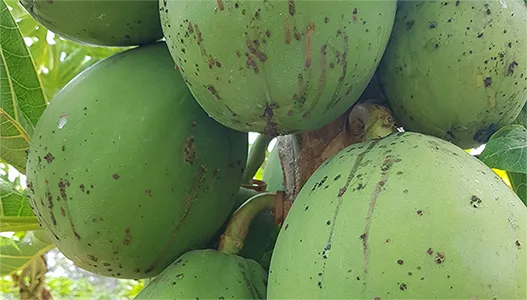
The hallmark sign of the disease is the production of excess, clear, and highly viscous latex on the surface of developing fruits and stems.
As the secreted latex oxidizes upon contact with air, it turns into sticky, brown-colored spots that significantly damage the fruit's skin.
Affected fruits often become malformed, and their aesthetic quality is severely compromised, rendering them unfit for commercial sale or consumption.
In addition to fruit symptoms, the plant may exhibit leaf chlorosis and a general decline in vigor, leading to stunted overall growth.
Severe infections can cause the fruit to stop maturing properly, leading to watery and tasteless pulp, which is a major quality issue for producers.
Pathogen
Papaya sticky disease, scientifically referred to as Papaya meleira (PMeV), is a viral disorder affecting Carica papaya plants. It is primarily associated with a virus belonging to the Totiviridae family.
The virus colonizes the laticiferous vessels of the papaya plant, causing an abnormal physiological response that results in the excessive and uncontrolled secretion of latex.
Transmission occurs primarily through mechanical contact, where infected latex comes into contact with wounded or susceptible tissues of healthy plants.
The virus remains active within the plant's vascular system, causing systemic infection that impairs the normal development of fruits and foliage.
While the virus is not yet fully characterized in terms of all insect vectors, mechanical transmission is the most confirmed and critical pathway for its rapid spread in agricultural fields.
Conditions for development
Papaya sticky disease thrives in tropical environments characterized by high humidity and consistent warmth, which are ideal for the plant's metabolic activity.
Any injury to the fruit or stem caused by wind, rain, insects, or pruning provides a direct entry point for the virus to infect the plant tissue.
High-density planting increases the frequency of plant-to-plant contact, creating ideal conditions for the spread of the pathogen throughout the orchard.
The lack of sanitation during harvesting and pruning operations is a major factor in the transmission of PMeV between healthy and diseased trees.
Variations in humidity can influence the rate of latex secretion, making symptoms more or less pronounced depending on the current climatic conditions.
Why it matters
The primary economic impact of Papaya sticky disease is the total loss of marketability of the papaya harvest due to the visible sticky scarring on the fruit.
Beyond external damage, the disease significantly reduces the sugar content and nutritional quality of the fruit, impacting consumer satisfaction.
Persistent infection weakens the papaya plant, leading to lower yields, reduced productive life cycles, and an increase in susceptibility to other opportunistic pathogens.
Large-scale infestations often require the removal of entire blocks of the orchard, resulting in significant capital and labor losses for the growers.
Since the disease can be easily spread during standard field operations, a single undetected case can potentially jeopardize the entire production area.
Protection
Strict phytosanitary practices are the cornerstone of disease management, requiring the immediate rogueing and destruction of any infected papaya trees.
Farmers must implement rigorous disinfection protocols for all tools, such as knives and pruning shears, between working on different plants to avoid virus transfer.
Integrated pest management should be employed to control insects that feed on the fruit, as their feeding marks can serve as primary infection sites.
Selecting planting sites with adequate spacing and wind protection can help reduce mechanical damage that might lead to infection.
- Routine monitoring for early signs of sticky exudate.
- Sanitation of contaminated tools with appropriate disinfectants.
- Development and use of resistant or tolerant cultivars for high-risk areas.
Discussion
No discussions yet — be the first.