
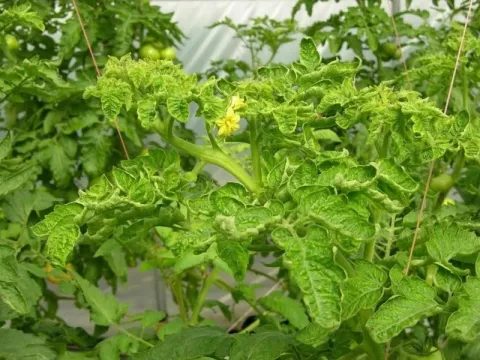
Tomato yellow leaf curl virus (Kokenae strain)
Begomovirus kokenae
The causal agent is the Tomato yellow leaf curl virus (TYLCV), specifically the Kokenae strain. It belongs to the Begomovirus genus within the Geminiviridae family.
What the section contains
Tomato yellow leaf curl virus (Kokenae strain)
The virus particles have a distinct twin-icosahedral structure containing a single-stranded circular DNA genome.
The primary vector for this virus is the whitefly Bemisia tabaci. The insect acquires the virus by feeding on infected phloem tissues of a host plant.
The virus circulates within the whitefly's hemolymph and accumulates in the salivary glands, allowing for persistent transmission throughout the insect's life.
Mechanical transmission via plant sap or agricultural tools is inefficient, which confirms that whitefly management is the most critical factor for controlling the spread.
Symptoms typically start at the growing points of the plant, where leaflets show yellowing, upward cupping, and reduced size.
The leaves often exhibit a crinkled texture, and the plants take on a bushy, stunted appearance due to the proliferation of lateral shoots.
Infected plants show poor flower development, with many flowers dropping off before fruit set, leading to severe yield loss.
Fruits produced on symptomatic plants are usually small, malformed, and lack the commercial quality required for fresh market sales.
The severity of the symptoms is often correlated with the age of the plant at the time of infection: earlier infection leads to more drastic stunting.
The spread of the disease is inextricably linked to the population dynamics and activity of Bemisia tabaci whiteflies in the field.
High temperatures and dry conditions favor the rapid reproduction of the insect vector, leading to explosive outbreaks of the virus.
In greenhouses, the virus persists year-round if alternative weed hosts or infected plant debris are not properly removed between cycles.
Migration of whitefly populations from surrounding fields or weeds acts as the primary source of initial viral inoculation for tomato crops.
Environmental light intensity plays a role in symptom expression, with higher light levels often making the yellowing and leaf curling more visible.
The Tomato yellow leaf curl virus is considered one of the most destructive and economically significant diseases for tomato production globally.
If infection occurs during the early seedling stage, yield losses can approach 100%, rendering the crop non-viable for harvest.
The virus impairs the physiological function of the plant, disrupting photosynthesis and overall nutrient assimilation throughout the growing season.
The Kokenae strain is noted for its high virulence and the ability to cause systemic infection across various cultivars of Solanum lycopersicum.
The need for intensive insecticide application to manage the vector increases production costs and can lead to environmental concerns and pesticide resistance.
Effective management requires an integrated pest management (IPM) approach centered on vector control and host resistance.
Breeding and utilizing resistant tomato hybrids remains the most sustainable and efficient strategy for managing TYLCV.
- Using insect-proof fine mesh screens on greenhouses to prevent whitefly entry.
- Implementing yellow sticky traps to monitor and reduce whitefly adult populations.
- Strict sanitation protocols, including the removal of weeds and infected plant debris.
- Crop rotation and avoiding overlapping planting cycles in high-risk areas.
- Timely application of effective systemic insecticides to manage whitefly nymphs and adults.