
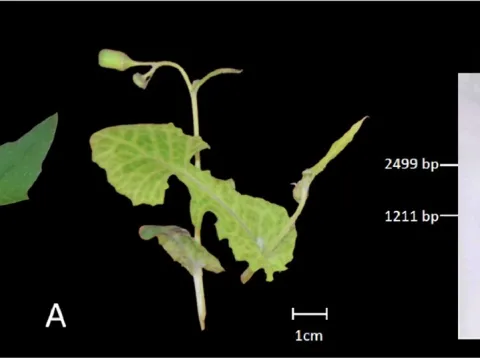
Emilia curly top virus
Begomovirus emiliae
The causative agent of this disease is the Emilia curly top virus (EmCTV), which belongs to the genus Begomovirus within the Geminiviridae family. It is characterized by a circular single-stranded DNA genome.
What the section contains
Emilia curly top virus
The virus is primarily transmitted by the tobacco whitefly, Bemisia tabaci. The insect acquires the virus while feeding on infected plant tissues and maintains the ability to transmit it throughout its adult lifespan.
The virus has a specific host range, primarily affecting plants within the Asteraceae family, such as Emilia species, and can occasionally infect other horticultural crops in subtropical and tropical regions.
Transmission occurs through a persistent circulative mechanism: the virus moves from the digestive tract into the hemolymph of the whitefly and eventually accumulates in the salivary glands for injection into healthy plants.
The biology of the pathogen is inextricably linked to the population dynamics of its whitefly vector, making the disease highly dependent on climatic conditions that favor insect reproduction.
The most distinctive symptom is the curling of leaf margins on the terminal shoots, which gives the disease its characteristic name. Leaves often show signs of severe deformation and cupping.
Affected plants exhibit significant growth retardation and stunting. Shortened internodes are commonly observed, leading to a compact, bushy appearance of the entire plant structure.
Foliage often displays chlorosis, yellowing, or intricate mosaic patterns. In advanced stages of infection, the leaf tissue may become thickened, brittle, or distorted in texture.
Flowering is typically suppressed in symptomatic plants. If flowers do form, they are often sterile or subject to premature abscission, resulting in a dramatic loss of fruit set.
Root systems in infected plants are often poorly developed compared to healthy individuals, leading to overall physiological weakness and increased vulnerability to environmental stress.
The development and spread of the disease are highly dependent on high ambient temperatures, which accelerate the life cycle and population density of the whitefly vector.
Dry weather conditions encourage the migration of whiteflies from wild reservoirs or drying vegetation toward irrigated crops, facilitating rapid transmission of the virus across fields.
Weed hosts serve as essential reservoirs for the virus during the off-season. The persistence of asymptomatic weeds allows the virus to survive and re-infect new crops when the vector becomes active.
The use of infected seedlings or propagation material is a primary driver of disease outbreaks. Once introduced into a field, the virus spreads rapidly if the insect vector population is present.
Agricultural practices that promote high plant density or poor ventilation can create favorable microclimates for the whitefly, indirectly contributing to higher incidence rates of the virus.
The primary damage caused by this virus is a significant reduction in yield and the degradation of fruit quality, rendering the produce unmarketable in commercial settings.
The viral infection disrupts the plant's metabolic pathways and photosynthetic efficiency, leading to severe physiological exhaustion and a loss of developmental vigor.
Secondary infections, such as opportunistic fungal or bacterial pathogens, often attack weakened, virus-infected plants, further complicating the clinical picture and total crop loss.
Large-scale epiphytotics can cause complete failure of crop cycles, leading to profound economic losses and the need for expensive remediation or complete removal of the affected area.
High management costs, including frequent pesticide applications to suppress vector populations, significantly inflate production expenses, reducing the overall profit margins for farmers.
The core management strategy involves integrated pest management (IPM) to control Bemisia tabaci populations using systemic insecticides and biological control agents.
Strict sanitation measures are crucial: removing and destroying weed hosts from the vicinity of fields and greenhouses significantly reduces the available virus reservoir.
Physical barriers, such as insect-proof netting in greenhouses, are highly effective in preventing whiteflies from landing on and infecting the crop seedlings.
Regular monitoring with yellow sticky traps is a recommended practice to detect the initial arrival of whiteflies, allowing for early intervention before the viral load becomes critical.
Roguing, or the systematic removal and disposal of infected plants showing early signs of curling, is essential to minimize the secondary spread of the virus within the field.