
Enamovirus
Enamovirus
Enamoviruses are a genus of plant viruses within the Solemoviridae family. They possess a single-stranded RNA genome and are characterized by a specific, persistent mode of transmission by aphid vectors.
What the section contains
Enamovirus
The most representative virus in this group is the Pea enation mosaic virus (PEMV). These viruses are not mechanically transmitted, meaning they do not spread through sap contact or handling, but depend entirely on their insect vectors.
Once an aphid acquires the virus, it remains infectious for a significant period. The virus replicates within the plant's vascular tissues, disrupting the phloem and interfering with the translocation of nutrients throughout the plant.
Enamoviruses often coexist with other viral components to complete their infection cycle. This complex biology makes them resilient and capable of causing systemic infections that persist for the life of the host plant.
The inability of the virus to spread via seeds or mechanical contact underscores the critical importance of controlling the aphid population in agricultural settings to limit the disease's reach.
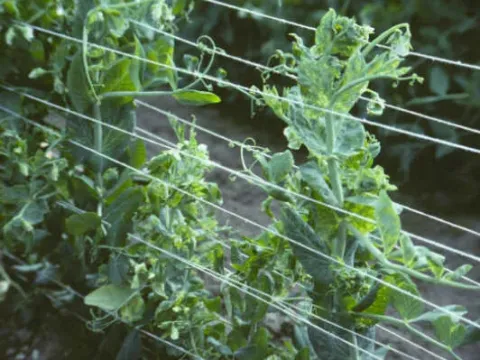
The name of the group refers to the characteristic "enations" or outgrowths that appear on the undersides of leaves. This is a primary diagnostic symptom for identifying the infection in the field.
In crops like chickpeas and peas, plants show severe leaf curling, wrinkling, and overall dwarfing. The internodes become shortened, giving the plant a stunted, bushy appearance that deviates significantly from a healthy phenotype.
Mosaic patterns are common, characterized by alternating patches of light green, yellow, and normal green tissue. This chlorosis is a direct result of the virus interfering with chlorophyll synthesis and plant metabolism.
Flowering is usually severely impaired. Plants may produce very few flowers, or the blossoms may drop prematurely, leading to a significant reduction in pod set and grain yield.
Pods that do develop are often deformed, shriveled, or smaller than usual. Seed development is also hampered, resulting in lower quality and lower overall weight of the harvested crop.
The spread of Enamovirus is intrinsically linked to the migration and population density of aphids. Warm, humid conditions favor both the reproduction of these vectors and their movement between fields.
Reservoir hosts play a crucial role in the disease cycle. Perennial legumes and wild weed species often harbor the virus during the winter months, serving as the primary source of infection for new spring crops.
When aphid populations reach a critical threshold, they move from wild reservoirs to cultivated fields, carrying the viral particles with them. The intensity of this movement dictates the rate of viral spread within the field.
Lack of spatial isolation between different legume plots is a major factor in disease development. When susceptible crops are planted near older, infected patches, the risk of rapid transmission increases exponentially.
Early-season infection is the most dangerous. If plants are colonized by viruliferous aphids at the seedling stage, the impact on plant growth and final yield is far more severe than later-season infections.
Enamovirus is highly detrimental to legume productivity. The primary damage involves a massive reduction in grain yield and quality, which directly impacts the profitability of the agricultural operation.
Infection in chickpeas leads to significantly lower seed weight and diminished nutritional content. Because the virus limits photosynthesis, the plant cannot store adequate proteins, reducing the market value of the crop.
Economic damage is exacerbated by the costs associated with aphid management. Farmers are forced to invest in repeated insecticide applications to protect their yields from the virus-carrying vectors.
Uniformity at harvest is often lost, leading to complications during mechanical operations. The combination of reduced yield and inconsistent maturity leads to substantial harvesting losses.
In extreme cases, the infestation causes such significant stunting that the crop fails to reach maturity, leading to total economic failure for the affected section of the field and necessitating replanting.
The primary control strategy is the intensive management of aphid populations. Systematic use of insecticides early in the season can significantly reduce the window for viral transmission.
Sanitation is essential; removing weed hosts in and around fields helps eliminate the viral reservoirs that sustain the pathogen between growing seasons, thereby reducing initial disease pressure.
Agronomic practices, such as optimizing planting dates to avoid peak aphid activity and maintaining proper spatial isolation between legume fields, are vital components of an integrated pest management strategy.
Breeding and selecting varieties with tolerance or resistance to the virus or the vector remains a major goal, as genetic resistance provides the most sustainable defense against viral diseases.
- Regular monitoring of aphid populations in fields.
- Use of certified, virus-free seeds.
- Effective weed control to remove reservoirs.
- Crop rotation to break the cycle of infection.