
Watermelon begomovirus
Begomovirus citrulli
The causative agent of the disease is the Watermelon chlorotic stunt virus (WmCSV), a member of the Begomovirus genus within the Geminiviridae family. This virus possesses a single-stranded circular DNA genome and is a significant pathogen of cucurbit crops.
What the section contains
Watermelon begomovirus
The virus acts as an obligate parasite, relying entirely on the host plant for replication. It lacks the ability to survive independently in the environment for extended periods without a suitable host or vector.
Wild cucurbit species and various weeds often serve as natural reservoirs for the virus, ensuring its survival during the off-season when primary host crops are not present.
Transmission occurs exclusively via insect vectors. Unlike many other plant viruses, it is not transmitted through seeds or simple mechanical contact, such as physical wounding or pruning tools.
Once introduced into the plant by the insect vector, the virus targets phloem tissue, where it replicates and spreads systemically throughout the entire plant, disrupting normal metabolic processes.
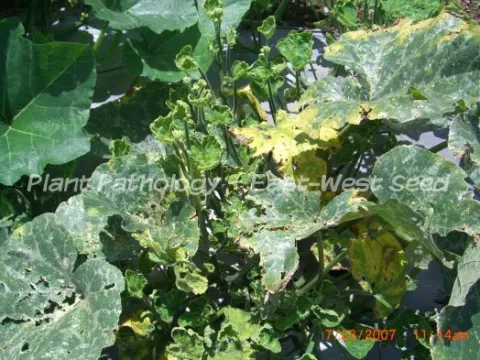
The primary symptom of infection is a distinct chlorotic mosaic pattern on the leaves. The foliage loses its natural green color, presenting with yellowish patches and irregular patterns.
Leaves exhibit severe curling and deformation. The leaf margins often roll downwards, and the surface becomes wrinkled or blistered due to the uneven development of plant tissues.
Infected plants show stunted growth and a significantly reduced overall size. Shortened internodes result in a dwarfed, bushy appearance, preventing the plant from developing sufficient vegetative biomass.
Flowering is heavily suppressed in affected specimens. If flowers develop, they are often deformed, leading to poor pollination rates and the formation of malformed, non-marketable fruits.
In severe cases, systemic necrosis may occur in the vascular bundles, leading to premature wilting and the total collapse of the plant in the field.
The development and spread of the disease are directly correlated with the presence and population density of the tobacco whitefly (Bemisia tabaci), which is the primary vector.
Environmental conditions that favor the rapid proliferation of whiteflies, such as high temperatures and dry climate, are optimal for the widespread transmission of the virus.
The movement of winged whiteflies from infested weeds or older crop fields to young watermelon seedlings facilitates the rapid expansion of the disease within a plantation.
Agricultural ecosystems with intensive cropping cycles provide a continuous food source for the whitefly, maintaining high viral load potential throughout the growing season.
Poor sanitation practices, such as failing to clear crop debris or surrounding weed patches, provide ideal shelter and breeding grounds for the vector populations.
Watermelon begomovirus causes devastating economic losses in watermelon cultivation due to significant reduction or total failure of fruit yield.
The damage extends to fruit quality; infected fruits are typically undersized, misshapen, and possess low sugar content, rendering them completely unsuitable for commercial markets.
The need for rigorous chemical control against vectors adds substantial costs to production, and the risk of recurring infection often forces growers to abandon susceptible crop varieties.
The insidious nature of the virus, which spreads via mobile insect populations, makes it difficult to contain without integrated management strategies and strict monitoring.
Large-scale outbreaks can destabilize regional agricultural sectors, potentially leading to localized failures in the supply chain for cucurbit crops.
The primary management strategy is the intensive control of the tobacco whitefly population. This requires the timely application of effective systemic and contact insecticides.
Agricultural practices, such as maintaining spatial isolation between fields and implementing effective weed management, are crucial to prevent the migration of insect vectors.
Early detection and rogueing—the immediate removal and destruction of symptomatic plants—can help localize the infection and prevent it from becoming a widespread epidemic.
Using physical barriers like floating row covers on young plants can significantly reduce the risk of whitefly infestation during the most vulnerable growth stages.
- Monitoring whitefly populations using yellow sticky traps.
- Prioritizing the use of resistant or tolerant cultivars when available.
- Strict adherence to crop hygiene to eliminate potential viral reservoirs.