
Powdery mildew
Erysiphe communis
Description
Symptoms
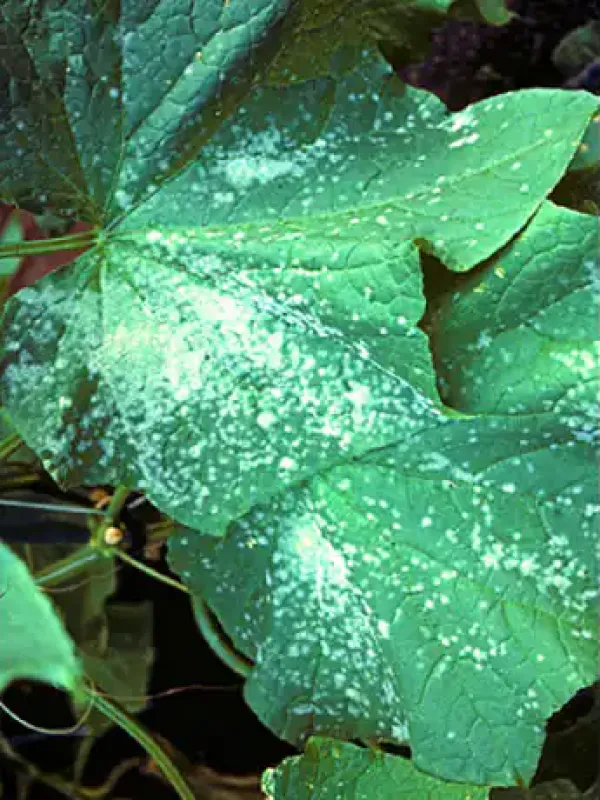
The primary visual symptom is the appearance of a characteristic white or powdery mat, initially appearing as small, scattered spots. Gradually, the mat spreads to cover leaves, stems, flower stalks, and even fruits.
This mat consists of a dense network of mycelium and conidia. As the infection progresses, it becomes denser, turning grayish or brownish due to the formation of wintering fruiting bodies.
Affected plant tissues deform, curl, and yellow. Leaves wither and drop prematurely, which significantly impairs the photosynthesis process and reduces plant vigor.
When young shoots are infected, they often become stunted or twisted. Flower buds may fail to open, and fruits may shrivel or drop, leading to significant yield losses.
In advanced stages, the plant appears as if dusted with flour. Under magnification, one can see tiny black dots, known as cleistothecia, appearing on the mycelium towards the end of the season.
Pathogen
The causative agent of the disease is a group of ascomycetous fungi from the order Erysiphales, specifically Erysiphe communis. These are obligate parasites that develop on the surface of plant tissues using specialized feeding organs called haustoria.
The fungus overwinters in the form of cleistothecia in plant debris or as mycelium inside the buds of perennial crops. In spring, spores are spread by wind or water, infecting young plant tissues.
The life cycle includes asexual reproduction via conidia, which are produced in massive numbers within the white fungal mat. This allows the pathogen to produce several generations during a single growing season.
The fungus parasitizes a wide range of plants, including cereals, vegetables, fruit crops, and ornamental plants. Its host specificity often depends on specialized forms of the fungus adapted to specific plant species.
The mycelium penetrates the plant epidermis, extracting nutrients and water. This weakens the plant, destroys protective tissue barriers, and leaves the host highly susceptible to secondary infections.
Conditions for development
The development of the fungus is favored by moderately warm weather (temperatures between 18–25 degrees Celsius) and high humidity. It is important to note that direct rain is not strictly required for spore germination.
Critical factors for spread include sharp temperature fluctuations between day and night, which induce heavy dew. This nocturnal humidity is often sufficient to trigger active fungal sporulation.
Dense plantings or poor ventilation in greenhouses create a microclimate that retains moisture on the leaf surface, providing perfect conditions for the pathogen to thrive.
Excessive nitrogen fertilization promotes the growth of soft, succulent tissues, which are easier for the fungus to penetrate. Conversely, a deficiency in potassium and phosphorus weakens the plant's natural immune system.
Poor crop rotation and the presence of weeds acting as alternative hosts near the fields also contribute to the rapid development of the disease throughout the season.
Why it matters
The disease leads to a drastic reduction in the photosynthesizing leaf area. This disrupts the plant's metabolism and energy storage, resulting in overall developmental stagnation.
Affected fruits lose their market value, often cracking or rotting. Storage quality is significantly reduced, as damaged skin provides easy entry points for various decay-causing bacteria.
In cereal crops, mass infection leads to shriveled grain and reduced yield weights. In orchards, the fungus extracts vital nutrients, reducing the plant's cold hardiness and the potential for fruit bud formation.
Economic losses include not only direct yield reduction but also the rising costs of frequent fungicide applications. Failure to control the disease can result in the loss of entire plantations.
Infected plants become highly vulnerable to environmental stressors, including drought, frost, and secondary pest attacks, as insects tend to thrive on weakened plants.
Protection
Preventive measures include strict crop rotation and the selection of resistant varieties or hybrids. This is the most reliable and environmentally sound approach to disease management.
Agricultural practices involve the timely pruning of infected shoots, the removal and destruction of crop residues in the autumn, and deep soil cultivation to disrupt the pathogen's cycle.
It is essential to balance plant nutrition, avoiding excessive nitrogen while ensuring sufficient potassium and phosphorus, which strengthen cell walls and improve resistance.
Chemical control is achieved through the use of fungicides, such as sulfur-based, triazole, or strobilurin products. Treatments must be applied at the first sign of symptoms for maximum efficacy.
In the early stages, biological controls like antagonistic bacteria or homemade remedies (e.g., sodium bicarbonate or ash solutions) can be used to alter the leaf surface pH and suppress fungal development.
Discussion
No discussions yet — be the first.