
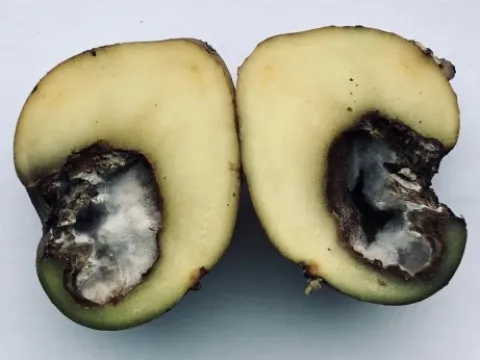
Potato gangrene
Phoma exigua
The causal agent of the disease is the fungus Phoma exigua var. foveata (and other species of the genus Phoma), classified as a deuteromycete. This pathogen is highly resilient and persists in soil, crop residues, and infected seed tubers.
What the section contains
Potato gangrene
The fungus penetrates tubers primarily through mechanical wounds, eyes, or lenticels. It produces pycnidia — specialized fruiting bodies that release massive quantities of spores, facilitating rapid secondary spread.
The pathogen is noted for its ability to remain latent in host tissues for extended periods, only becoming active when environmental conditions become conducive to disease development.
The life cycle involves mechanisms that allow it to adapt to various environmental stresses, making it a persistent threat in both field and storage settings.
Primary infection is most frequently introduced into a field via contaminated seed lots, underscoring the importance of rigorous quality control for planting material.
The disease is commonly known as potato gangrene. Early symptoms appear as small, slightly depressed, circular spots on the tuber surface, which eventually expand and deepen.
Tissues under these spots undergo rapid decay, becoming dry, dark, and friable. When cut open, a distinct, often dark or black, margin is visible between the infected and healthy tuber tissue.
Concentric skin folds often develop in the center of the depressed lesions. Under high humidity, cavities may form inside the lesion, lined with a grayish mycelial mat.
On haulms, the disease manifests late in the season as dark, irregular brown spots, where black pycnidia eventually emerge as small dots.
Premature senescence of stems due to infection negatively impacts tuber filling, leading to a significant reduction in total marketable yield.
Cool and wet weather during the latter part of the growing season is highly favorable for disease development. The optimum temperature for tuber infection ranges from 12 to 18 degrees Celsius.
In storage, gangrene thrives under high relative humidity (above 90%) and poor ventilation, especially if tubers sustained mechanical damage during harvest.
Soil conditions, such as high acidity or potassium deficiency, can weaken plant defenses, making tubers more susceptible to pathogen colonization.
Spore dissemination within storage units occurs via air currents and moisture droplets that condense on tuber surfaces during temperature fluctuations.
Infected plant debris remaining in the soil acts as the primary reservoir for the fungus, making crop rotation essential for inoculum suppression.
The primary economic impact occurs during storage, where gangrene can infect large batches of potatoes, resulting in significant storage rot losses.
Infected tubers quickly lose their marketability and weight due to desiccation, rendering them unsuitable for both culinary use and industrial processing.
Affected lots are entirely unsuitable for use as seed potatoes, as the pathogen is easily transmitted to the following season's crop.
In the field, the disease causes early plant wilting, which disrupts photosynthesis and limits tuber development, reducing the overall number and size of harvested tubers.
If phytosanitary protocols are neglected, losses can reach 30–50% of the stored inventory, causing severe financial damage to agricultural operations.
The cornerstone of protection is the use of pathogen-free seed potatoes and a strict crop rotation schedule, avoiding potato cultivation on the same plot for at least 3–4 years.
It is vital to minimize mechanical injury during harvest and ensure thorough curing and drying of tubers before moving them into storage facilities.
Maintaining a stable microclimate within storage, particularly by ensuring adequate airflow to prevent surface condensation, is crucial for disease prevention.
- Applying appropriate fungicide treatments to seed tubers before planting.
- Timely haulm destruction prior to harvest to reduce tuber infection risk.
- Balanced nutritional programs, with particular attention to potassium and boron levels.
If symptoms appear in storage, affected lots should be sorted immediately to remove diseased tubers, followed by intensified ventilation of the storage area.