
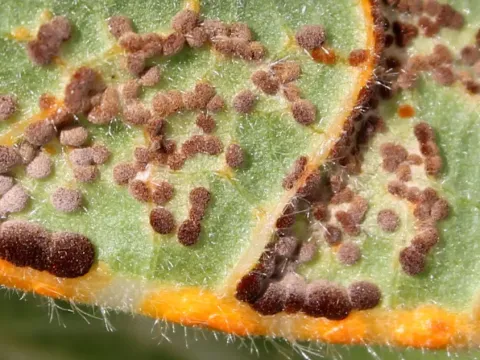
Hollyhock rust
Hollyhock leaf
The causal agent of this disease is the fungus Puccinia malvacearum, a basidiomycete pathogen. It is an obligate parasite, meaning it requires living host tissue from the Malvaceae family to survive and reproduce.
What the section contains
Hollyhock rust
Unlike many other rust fungi, this species is autoecious, completing its entire life cycle on a single host. This simplifies the infection process, as the fungus does not require an alternate host plant to spread effectively.
The fungus produces teliospores in structures known as telia, which appear as pustules on the host plant. These spores are highly resilient and can withstand environmental stressors, allowing the fungus to persist from one season to the next.
Overwintering occurs primarily through infected plant debris left in the soil or on evergreen basal leaves. When spring conditions arrive, these spores germinate and initiate new infections on emerging foliage.
Dissemination occurs via wind, water splashes, and physical movement. Because the spores are light and easily airborne, the disease can spread rapidly through a garden if not managed promptly upon detection.
The primary symptom of hollyhock rust is the appearance of small, circular, raised spots on the undersides of leaves. These spots, often yellow or orange-brown, are the fungus's reproductive pustules.
As the infection progresses, these pustules multiply and become visible on the upper leaf surface as chlorotic or yellow-speckled areas. The disease eventually spreads to stems and leaf stalks as well.
Severely infected leaves become brittle, curl, and eventually drop off. This results in significant defoliation, particularly at the base of the plant, which drastically reduces the plant's aesthetic appeal.
On stems, the rust pustules often form in elongated clusters or rows. This internal colonization interferes with the plant's ability to transport water and nutrients efficiently, leading to stunted growth.
- Orange-brown pustules on leaf undersides.
- Yellowing and premature shedding of leaves.
- Visible fungal growths on stems and stalks.
- Leaf deformation and curling.
- Reduced plant vigor and stunted development.
Hollyhock rust thrives in cool, humid conditions. Prolonged wet weather, high atmospheric humidity, and poor air circulation create the perfect environment for the fungus to germinate and spread.
Temperature plays a crucial role, with optimal growth occurring between 15°C and 22°C (59°F to 72°F). During damp spring and summer months, the disease can reach epidemic levels if environmental conditions remain favorable.
Crowded plantings significantly worsen the problem by trapping moisture and preventing leaves from drying out. When plants are spaced too closely, humidity levels between leaves rise, facilitating rapid spore germination.
Lack of direct sunlight also contributes to disease development. Plants located in shaded or enclosed areas tend to stay damp longer after rainfall or dew, increasing their susceptibility to fungal colonization.
Plants that are stressed due to improper watering, poor soil fertility, or environmental changes are significantly more susceptible to infection compared to vigorous, well-maintained hollyhocks.
The primary damage caused by hollyhock rust is the destruction of photosynthetic tissue. As the leaves wither and fall, the plant loses its ability to produce energy, which is essential for healthy flowering.
The systemic impact on the plant's vascular system leads to smaller, deformed blossoms or a complete failure to flower. In severe cases, the plant may suffer from chronic decline and eventual death.
The accumulation of rust spores in the garden environment makes it increasingly difficult to grow healthy hollyhocks in the same location. Without intervention, the disease pressure increases annually.
Loss of foliage and plant health results in a diminished landscape aesthetic. The plants lose their structural beauty, making them unsuitable for decorative gardening purposes and frustrating for horticulturalists.
For perennial varieties, the stress caused by rust can be fatal, preventing the plant from storing enough reserves to survive harsh winter conditions, thereby ending the plant's life cycle prematurely.
Good garden hygiene is the first line of defense. Always remove and dispose of infected plant parts immediately. In the fall, clear all plant debris to eliminate the primary source of overwintering spores.
Ensure adequate spacing between plants to promote airflow and decrease humidity levels. Select sunny locations for planting to ensure foliage dries quickly after rain or dew.
When watering, target the root zone rather than the foliage. Using drip irrigation or a soaker hose prevents water from splashing onto the leaves, which is a common way for rust spores to transfer.
If an outbreak occurs, fungicide applications may be necessary. Use products containing copper, mancozeb, or systemic triazoles. Follow label instructions carefully, applying them at regular intervals during the growing season.
Monitor plants regularly, especially during the spring. Early detection and the removal of the first few infected leaves can often prevent a full-scale outbreak, saving the rest of your garden from infection.