
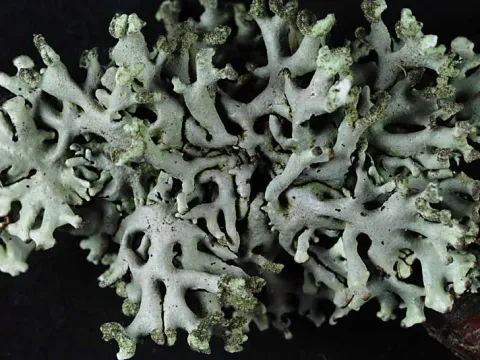
Hypogymnia physodes
Hypogymnia physodes
Hypogymnia physodes, commonly known as the monk's-hood lichen, appears as a grayish-green or brownish foliose structure attached to tree bark.
What the section contains
Hypogymnia physodes
The thallus is composed of hollow, inflated lobes, which often have darkened or blackish tips, giving the lichen a distinct aesthetic appearance.
It typically forms circular, rosette-like patches that may expand and merge to cover significant portions of the trunk or larger branches.
When dry, the lichen becomes brittle and can be easily detached from the bark surface without causing immediate physical trauma to the tree.
Unlike parasitic fungi, this lichen does not penetrate deep into the woody tissues, remaining strictly on the outer bark surface.
Biologically, Hypogymnia physodes is not a plant pathogen; it is a symbiotic organism consisting of a fungus and a photosynthetic partner.
As an epiphyte, it relies on the tree only as a substrate for physical support and obtains all its nutrients from air, rain, and dust.
It does not extract sap or sugars from the host plant, meaning it does not cause disease by nutrient deprivation.
The organism reproduces through fragments of the thallus or spores, which are dispersed by wind and rain onto nearby surfaces.
While often mistaken for a disease, its presence is usually a marker of environmental conditions rather than an active infection process.
This lichen thrives in areas with high atmospheric humidity, frequently colonizing trees in neglected, overcrowded, or shaded orchards.
Trees with slow-growing or aging bark provide the most stable surfaces for the colonization of Hypogymnia physodes over long periods.
A lack of proper pruning and canopy management restricts airflow, creating persistent micro-climates that are ideal for lichen growth.
Pollution levels also influence its presence; while sensitive to extreme air toxicity, it is remarkably common in temperate garden ecosystems.
Stagnant air within the canopy, especially in low-lying areas with poor drainage, facilitates the rapid spread of the lichen thallus.
While not a parasite, heavy colonization of Hypogymnia physodes can create problems by retaining moisture against the tree bark.
This persistent moisture can harbor wood-boring insects, scale insects, and mites that utilize the lichen as protective shelter.
A thick layer of lichen can slightly impede gas exchange in the bark, potentially affecting the tree's health if the colonization is massive.
The presence of abundant lichen often signals that the tree is in decline, has low vigor, or lacks the healthy bark shedding cycle.
If left unmanaged, the damp conditions beneath the lichen can soften the outer bark, making it more prone to secondary fungal infections.
Mechanical removal is the safest and most effective way to manage lichens: simply scrub the bark with a stiff bristle brush.
Perform maintenance during the dormant season to avoid disturbing the tree’s active growth phase or damaging sensitive buds.
Follow up with an application of a horticultural soap or a copper-based fungicide to disinfect the bark surface and prevent regrowth.
Improve overall tree vigor through balanced fertilization and correct watering practices to encourage healthy, faster bark shedding.
- Regular thinning cuts to improve airflow throughout the canopy.
- Annual trunk washing with approved horticultural mixtures.
- Monitoring for underlying pests often concealed by lichen cover.