
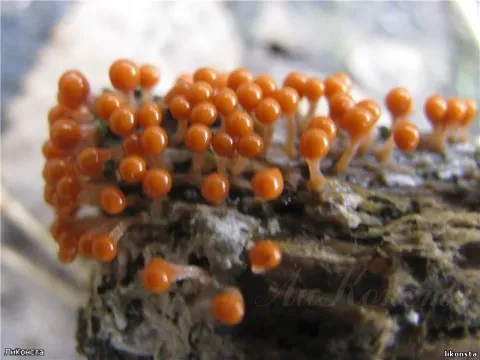
Hemitrichia calyculata
Hemitrichia calyculata
The primary sign of Hemitrichia calyculata is the appearance of characteristic fruiting bodies, known as sporangia, which develop on decaying plant matter, bark, or damp wood. These structures resemble tiny cups on slender stalks and are typically golden-yellow or ochre in color.
What the section contains
Hemitrichia calyculata
Sporangia often grow in clusters, forming visible colonies. Once mature, the outer membrane ruptures, releasing a mass of spores that gives the colony a powdery or dusty appearance, which is a classic diagnostic feature.
Unlike pathogenic fungi, the mycelium-like structures of this slime mold rarely penetrate living tissues deeply, but their presence can cover significant surface areas, causing visual deformation and structural stress to the plant.
The presence of this organism is often accompanied by the plasmodium stage — a motile, slimy structure that migrates across surfaces in search of nutrients like bacteria, fungal spores, and organic debris.
An important diagnostic feature is the elasticity of the sporangia; they become brittle when dry but can regain their flexible, elastic nature upon re-moistening, distinguishing them from true fungal pathogens.
Hemitrichia calyculata is not a true fungus or plant; it is a member of the Myxomycetes (slime molds), which belong to the kingdom Protista.
Its life cycle involves an active plasmodium stage, which is a mobile, amoeboid mass that feeds by engulfing particles of organic matter and microscopic organisms.
The organism reproduces through spores, which are dispersed by wind or water. In conditions of high humidity, these spores germinate into motile cells that eventually fuse to form a new plasmodium.
From an agronomic perspective, this organism acts as a saprotroph, inhabiting weakened or decaying plant parts, though its presence is often a strong indicator of poor drainage or neglected crop hygiene.
Taxonomically, it belongs to the order Trichiales within the family Trichiaceae, which explains its unique physiological properties and general resistance to standard agricultural fungicides.
The development of Hemitrichia calyculata is strictly dependent on high environmental humidity, typically ranging from 80% to 100%. Shaded areas with limited air circulation are the most vulnerable.
The organism thrives in a temperature range of +15°C to +25°C, which supports the transition from the dormant spore stage to the active, vegetative plasmodium stage.
High accumulations of decaying organic matter, such as leaf litter, mulch, or rotting timber, provide the essential nutrition needed for the rapid expansion of slime mold colonies.
Poor ventilation in greenhouse environments or excessively dense plant spacing in open fields leads to moisture accumulation on foliage, creating ideal paths for the plasmodium to travel between plants.
Failure to implement regular sanitation practices, specifically leaving plant debris on the soil surface, is the primary factor driving mass sporulation during spring and autumn.
Although Hemitrichia calyculata is primarily a saprotroph, it poses an indirect threat by blocking sunlight and air from reaching the plant surface, thereby inhibiting photosynthesis and slowing growth.
The dense covering of slime can trap moisture and create a microenvironment conducive to secondary infections from bacteria and common molds, which can cause genuine damage to the plant tissues.
In ornamental horticulture, the presence of these conspicuous yellow fruiting bodies significantly lowers the aesthetic value and marketability of the plants, rendering them unsuitable for sale.
For young seedlings, the coverage by a plasmodium can be detrimental, leading to stem deformation and potential death due to the impairment of vital gas exchange processes.
Furthermore, its presence serves as a warning sign of poor drainage or overwatering, which may lead to the development of root rots that are far more damaging to the overall health of the crop.
The first line of defense is strict crop hygiene: removing all plant debris, fallen leaves, and rotting wood from the site immediately, as these are the primary substrates for slime mold growth.
Implementing a precise irrigation strategy that prevents surface waterlogging and avoids wetting the foliage or stems, especially toward the end of the day, is crucial for control.
Improving greenhouse ventilation and thinning out dense plant clusters in the field helps lower humidity levels, creating an environment that is hostile to the survival of the plasmodium.
Upon detection, fruiting bodies should be mechanically removed and disposed of carefully to prevent the dispersal of spores throughout the production area.
- Maintain proper soil aeration through regular hoeing and cultivation.
- Use beneficial soil microbiota or bio-fungicides to manage the surface environment.
- Ensure adequate drainage systems to prevent the buildup of stagnant water.