
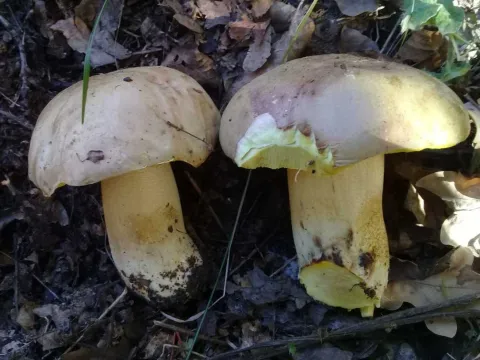
Semi-baking bolete
Xerocomus impolitus
The semi-baking bolete, scientifically known as Xerocomus impolitus (also classified as Hemileccinum impolitum), is not a plant pathogen or a disease agent. It is a beneficial fungus that belongs to the Boletaceae family.
What the section contains
Semi-baking bolete
Instead of causing diseases, this fungus plays a vital ecological role by forming mycorrhizal associations with the roots of various deciduous trees, such as oaks, beeches, and hornbeams.
In this symbiotic relationship, the fungus provides the tree with essential minerals and water, while the tree provides the fungus with sugars produced through photosynthesis.
The organism is a forest-dwelling mushroom that contributes to soil health and nutrient cycling. It is classified as an edible mushroom, though it must be carefully distinguished from toxic look-alikes.
Recognizing the organism as a symbiotic fungus rather than a pathogen is crucial for forest management. Its presence is generally considered an indicator of a mature and healthy woodland ecosystem.
The cap of the semi-baking bolete typically measures between 5 and 15 cm in diameter. Its surface is dry, matte, and ranges in color from light brown to tan, often resembling suede leather.
The underside features yellow pores that turn olive-yellow as the mushroom matures. Notably, the pore surface does not change color when bruised or touched, which is a key diagnostic feature.
The stem is thick and robust, often club-shaped at the base. It is pale yellow in color and is covered in fine, granular scales rather than a raised net-like pattern (reticulation).
The flesh is firm and whitish to pale yellow in color. Unlike many other bolete species, the flesh does not change color (it does not bruise blue or red) when exposed to air.
A distinctive feature of the raw fungus is its unusual scent. It often emits a mild chemical or medicinal aroma, similar to carbolic acid or iodine, which dissipates during the cooking process.
This species thrives in warm, temperate deciduous forests. It is most commonly associated with mature oak stands that provide the necessary host conditions for its mycelium.
The fungus prefers well-drained soils, often with a clay or loam composition. It requires a balanced moisture level, avoiding both waterlogged soils and prolonged periods of severe drought.
Growth is typically observed from early summer through late autumn. The peak of its fruiting season is heavily influenced by warm temperatures following periods of sustained rainfall.
Light penetration in the forest is an important factor. It is frequently found along forest edges or in somewhat open woodlands where the forest floor receives adequate warmth.
Stability of the habitat is essential. Because it forms long-term mycorrhizal bonds, it is rarely found in young or frequently disturbed forests, preferring established woodland areas.