
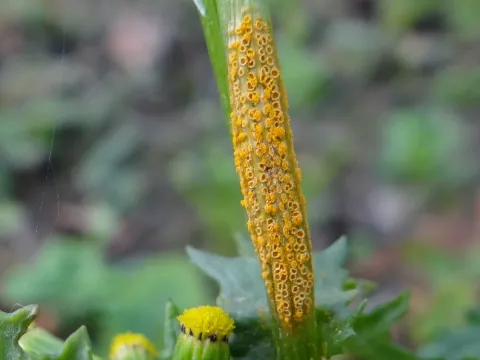
Senecio rust
Russula senecis
The disease is caused by the specialized rust fungus Puccinia lagenophorae, which acts as an obligate parasite affecting various species within the Asteraceae family, particularly the genus Senecio.
What the section contains
Senecio rust
As an obligate pathogen, this fungus relies entirely on living plant tissue to complete its life cycle and produce successive generations of spores for propagation.
The fungus penetrates plant leaves via stomata, where it establishes a mycelium network that extracts nutrients, effectively hijacking the plant's metabolic processes.
Spores produced by the fungus are highly lightweight and can be easily dispersed over long distances by wind or water splashes, facilitating rapid spread.
The biological cycle is well-adapted to temperate climates, often allowing the pathogen to persist on host plants or debris throughout the growing season.
The primary symptom is the formation of small, circular, orange-to-brown pustules, known as aecia, which typically appear on the abaxial (underside) surface of the leaves.
Over time, these pustules rupture the plant epidermis, releasing a dusty mass of spores that can visibly coat the surrounding foliage.
Infected leaves often exhibit yellowing (chlorosis) around the infection sites, followed by curling, necrosis, and premature senescence of the foliage.
Severe infestations can lead to systemic effects, where the entire plant exhibits stunted growth, distorted stems, and significantly reduced vigor.
- orange-brown powdery pustules;
- yellowing and necrosis of leaves;
- stunting of vegetative growth;
- premature leaf drop.
Senecio rust development is highly dependent on environmental conditions, particularly high relative humidity and temperatures between 15°C and 22°C.
The presence of free moisture, such as dew, fog, or rainfall, on the leaf surface is essential for spore germination and successful infection of host tissues.
Poor air circulation, often resulting from high plant density, creates a humid microclimate that significantly favors the rapid germination and spread of the fungus.
Periods of prolonged cool, wet weather provide the optimal window for the pathogen to establish and multiply, often leading to sudden outbreaks.
Plants under physiological stress, such as those grown in poor soil or with nutrient imbalances, are often more susceptible to infection by rust fungi.
The major impact of this disease is the destruction of photosynthetic tissue, which severely limits the plant's ability to produce energy and maintain growth.
Reduced vigor often results in impaired flowering and seed production, affecting the plant's long-term survival and reproductive success.
In cases of heavy rust infection, the overall biomass of the plant is significantly compromised, leading to weakness and increased vulnerability to secondary infections.
The loss of foliage affects water regulation, making the plant more susceptible to drought stress and other environmental stressors.
In agricultural systems, rust can significantly lower the quality and yield of susceptible crops, requiring immediate management interventions.
Cultural control is the first line of defense, including the removal and destruction of infected plant material to prevent the buildup of inoculum.
Implementing proper crop rotation and maintaining adequate spacing between plants improves airflow and helps to reduce humidity levels within the canopy.
Monitoring fields during the early stages of the growing season allows for the early detection and management of infection hotspots before they spread.
Where necessary, the use of systemic fungicides can be effective in protecting high-value crops from rust infection during periods of high risk.
Improving general plant health through proper fertilization and irrigation management can help crops better withstand the negative effects of the disease.