
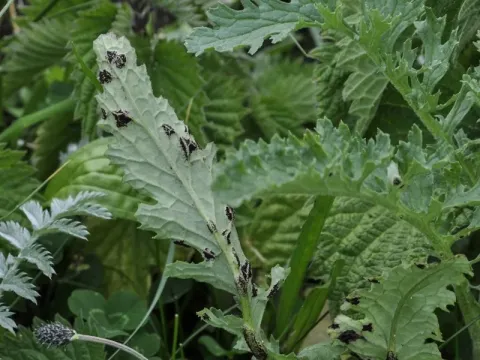
Senecio rust
Puccinia glomerata
The causal agent of this disease is a highly specialized parasitic fungus Puccinia glomerata, belonging to the division Basidiomycota. This is an obligate parasite that relies entirely on the nutrients from living tissues of the host plant, in this case, species of the genus Senecio.
What the section contains
Senecio rust
The fungus life cycle occurs on a single plant or may involve a shift in developmental stages characteristic of rust fungi. Sporulation is represented by urediniospores and teliospores, which ensure both massive infection spread during the growing season and the survival of the pathogen throughout the winter.
The fungal mycelium develops within the leaf and stem tissues, penetrating intercellular spaces and forming haustoria to absorb nutrients. The pathogen is a typical member of the pathosystem causing specific rust-like tissue deformation.
Infection spreads primarily via the wind, which carries light spores over significant distances. Upon landing on a susceptible host under conditions of surface moisture, the spore germinates and penetrates through the stomata.
The biology of Puccinia glomerata is closely linked to the population density of Senecio. Under high plant density, the fungus can rapidly cover large areas, forming epiphytotic disease centers.
Early symptoms appear as small chlorotic spots on the upper side of the leaf blade, which gradually darken. Soon, characteristic pustules form on the underside of the leaves—these are rupture points in the epidermis through which the fungal spores emerge.
The pustules usually have a bright orange or brownish hue, which gives the disease its common name, rust. With severe infections, these spore clusters can cover almost the entire surface of the leaf blade, as well as stems and petioles.
Leaves of infected plants gradually lose turgor, begin to yellow, and wither prematurely. Photosynthesis in the affected areas is blocked, leading to a marked inhibition of the plant's vital functions.
Microscopic examination of the pustules reveals clusters of unicellular or bicellular spores with characteristic shapes and colors. At the end of the growing season, pustules may change color to a darker, almost black shade due to the formation of teliospores.
The appearance of the infected Senecio becomes unsightly, characterized by organ deformation, stem curvature, and general stunted growth compared to healthy specimens.
Disease development depends directly on climatic factors, particularly moisture levels and temperature. The optimal temperature for spore germination ranges between +15 and +22 degrees Celsius.
High relative humidity, frequent dew, fog, or prolonged rainfall are decisive factors for infection. Surface moisture is essential for spores to activate and penetrate the plant epidermis.
Dense plantings or wild patches of Senecio create a microclimate with reduced aeration, where moisture lingers longer on leaves, facilitating rapid spread of infection within the cluster.
The fungal incubation period—from infection to the emergence of new spores—can be as short as 7–10 days under favorable conditions, triggering a rapid accumulation of infectious potential.
The presence of plant debris infected with rust from the previous season serves as a primary source of initial inoculum, as the fungus is capable of remaining viable in the form of dormant spores.
The damage caused by Senecio rust primarily involves the disruption of plant physiological processes. The infection suppresses assimilation processes, leading to a sharp decrease in biomass accumulation.
Infected individuals show reduced flowering intensity, produce fewer seeds, or experience a significant decrease in seed quality. If the disease attacks young plants, complete death due to exhaustion is possible.
In ornamental gardening, rust is a serious aesthetic problem that devalues the decorative qualities of the plant. Infected plantings require immediate removal or treatment, which incurs additional labor costs.
During intense pathogen development, the plant's water balance is disrupted. Due to epidermal damage, leaves lose moisture significantly faster, making the plant highly vulnerable to drought periods.
At the ecosystem level, the pathogen acts as a population regulator, limiting excessive growth of Senecio, although in cultivation, this disease is classified as a hazardous factor that reduces biological productivity.
The primary control method involves adhering to agronomic rules aimed at preventing the formation of a favorable microclimate for the fungus. It is important to avoid dense plantings, ensuring good air circulation.
Regular monitoring and the removal of isolated infected plants (phytosanitary weeding) are mandatory to prevent spore spread to healthy areas.
Timely cleaning and destruction of plant debris at the end of the season drastically reduce the inoculum reservoir in the area. Burying debris in compost or burning it interrupts the pathogen's life cycle.
In cases of massive infestation, chemical fungicides with systemic or contact action are used, including copper-based, sulfur-based, or modern azole compounds effective against rust fungi.
- Implementation of crop rotation.
- Usage of resistant Senecio varieties.
- Optimization of watering regimes to avoid getting moisture on leaves.
- Fungicide treatment at the first signs of pustule appearance.