
Septobasidiales
Septobasidiales
Description
Symptoms
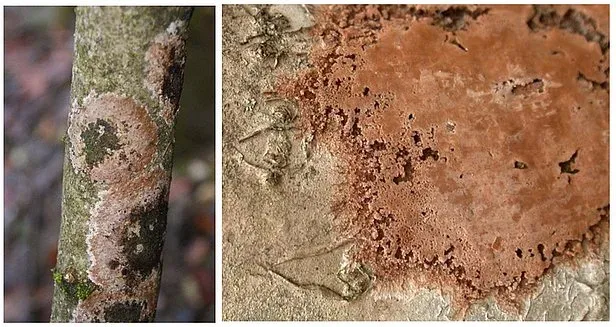
The primary symptom of Septobasidiales infection is the appearance of fungal mats or crusts on the branches and trunks of trees. These structures often possess a velvety or leathery texture that adheres closely to the bark surface.
The color of these colonies typically ranges from grayish-brown to dark brown, making them easily overlooked against the background of weathered tree bark.
Infected areas often appear as irregular, slightly raised patches or thick, leathery coatings. In some cases, the fungal mycelium may encircle the branch entirely, creating a sleeve-like appearance.
Under close examination, the surface of the fungal mat may show a porous or granular texture. Some older colonies may exhibit surface cracking, revealing lighter-colored mycelial layers beneath.
Unlike common lichens, these fungal mats are more intimately associated with the bark tissues and are almost invariably accompanied by colonies of scale insects.
Pathogen
The pathogens belong to the order Septobasidiales, which are obligate symbionts. They maintain complex biological relationships with insects, specifically scale insects (coccids).
The fungus forms protective fungal structures, often referred to as «mats» or «houses,» over the colonies of scale insects feeding on the tree bark.
The biology of the pathogen is deeply intertwined with the life cycle of the host insects. The fungus derives nutrients from the insects without killing them, ensuring a long-term parasitic or commensal association.
The condition can be classified as a complex parasitocenosis, where the fungus acts simultaneously as an entomopathogenic organism and an epiphyte colonizing the plant surface.
Reproduction occurs primarily through basidiospores, which are dispersed by wind or rain splash, enabling the colonization of new scale insect populations on the tree limbs.
Conditions for development
The development of Septobasidiales is favored by regions with high atmospheric humidity and moderate temperatures, typical of subtropical and tropical climates.
Densely planted orchards or unpruned trees, where airflow is restricted, create a microclimate that maintains the high moisture levels necessary for fungal survival.
The presence of scale insect populations is a prerequisite for the establishment of the fungus. Without the host insects, the fungus cannot thrive or develop its characteristic mats.
Poor orchard sanitation, characterized by the accumulation of dead wood and lack of canopy management, allows the fungus to propagate unchecked across the tree structure.
Seasonally high precipitation levels provide the hydration needed for spore germination and the expansion of mycelial colonies on the bark surface.
Why it matters
While the direct damage caused by the fungus to the tree is often considered secondary to the damage caused by the scale insects, the fungus still contributes to the overall decline of the branch.
The thick fungal mats can physically obstruct gas exchange through the bark lenticels, potentially stressing the local tissue and reducing the vigor of the affected limb.
The tree suffers from the cumulative impact of both the parasitic insect feeding and the presence of the fungal crusts, leading to weakened growth and reduced resilience.
Prolonged infestations can result in the dieback of affected branches, significantly decreasing the yield and aesthetic value of fruit and ornamental trees.
In nursery settings, the presence of these fungi is a key indicator of poor pest control management, necessitating immediate intervention to prevent the spread to healthy stock.
Protection
The primary control strategy focuses on managing the populations of scale insects. Applying systemic insecticides during the crawler stage of the insects effectively disrupts the symbiotic life cycle of the fungus.
Sanitary pruning should be conducted to remove and destroy heavily infested branches. It is essential to dispose of the pruning debris by burning to minimize re-infection risks.
Improving air circulation within the canopy through proper pruning techniques helps to lower local humidity levels, making the environment less conducive to fungal growth.
Dormant season sprays, such as copper-based fungicides or horticultural oils, can help cleanse the bark surface and reduce the overall infection pressure on the tree.
Maintaining high standards of orchard vigor through proper fertilization and irrigation helps trees recover more effectively from pest and fungal infestations.
Discussion
No discussions yet — be the first.