
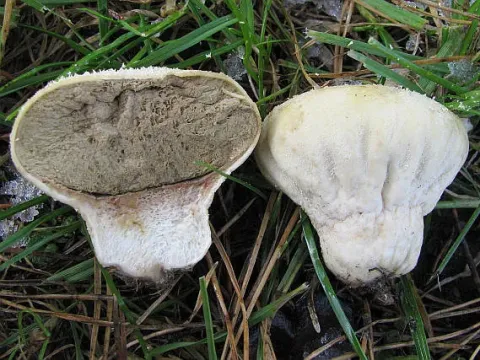
Vascellum pratense
Vascellum pratense
Vascellum pratense (formerly known as Lycoperdon pratense) is a basidiomycete fungus within the Agaricaceae family. It is classified as a saprophyte, meaning it derives nutrients from decaying organic matter rather than living plants.
What the section contains
Vascellum pratense
In agronomy, it is often confused with plant diseases, though it does not attack crop tissues. Its presence is primarily an indicator of soil composition and the accumulation of plant residues.
The fungus features a distinct fruiting body with a spherical head and a sterile base. As it matures, the outer skin degrades, allowing spores to be released into the environment.
Its biological activity is focused on the decomposition of organic debris, contributing to the recycling of nutrients within the soil ecosystem under appropriate conditions.
The life cycle is closely linked to the availability of organic mulch or stubble, making it a common feature of fields with high concentrations of unincorporated biomass.
The primary sign of the fungus is the emergence of small, spherical or club-shaped fruiting bodies, typically appearing on the soil surface after rainfall.
In the early stages of development, the mushrooms are white or cream-colored, eventually turning brownish as the spore mass matures within the fruiting body.
They are most commonly found in damp areas of the field where crop residue, such as straw or hay, has been left on the surface without adequate decomposition.
When disturbed, the mature fruiting body releases a cloud of spores, which is a key characteristic to identify this particular type of field fungus.
- White spherical fruiting bodies appearing in clusters.
- Spore release upon mechanical impact.
- Visible fungal mycelium under thick layers of rotting crop debris.
The growth of Vascellum pratense is strongly dictated by soil moisture and temperature. Humid conditions following the crop harvest are optimal for fruiting.
The fungus thrives in soils rich in organic matter where proper tillage practices have been neglected, leaving a substantial layer of debris on the surface.
Poor soil aeration and compaction create a sheltered environment that allows the fungal mycelium to colonize the surface layers effectively.
Fields managed under no-till systems may show higher frequencies of this fungus if the rate of residue decomposition is slower than the rate of accumulation.
Neutral or slightly acidic soil conditions provide the most favorable environment for this species to flourish alongside other soil microbiota.
Vascellum pratense is not a pathogen and poses no direct threat to the physiological health of living crops.
However, significant growth can indicate that high amounts of crop residue are not being mineralized efficiently, potentially leading to nutrient tie-up, particularly nitrogen.
Massive outbreaks can interfere with field operations, as the physical presence of mushrooms and fungal mats can hinder sowing or harvesting equipment.
Large quantities of airborne spores during maturation may cause respiratory irritation for farmers or equipment operators working in the field.
High densities of this fungus serve as a visual indicator of suboptimal field sanitation, suggesting the need for improved residue management strategies.
The most effective strategy to manage this fungus is the proper incorporation of crop residues into the soil, often assisted by the application of stubble decomposers.
Maintaining a balanced crop rotation prevents the buildup of specific organic debris that supports the colonization of Vascellum pratense.
Improving soil aeration through timely mechanical or biological tillage helps accelerate the decomposition process, leaving less substrate for the fungus.
Liming soils to optimize the pH can help adjust the microbial balance in the soil, making it less hospitable for this particular saprophyte.
Chemical control is generally not recommended or necessary, as the organism is not harmful to crops; focus should remain on sound agrotechnical practices and soil health.