
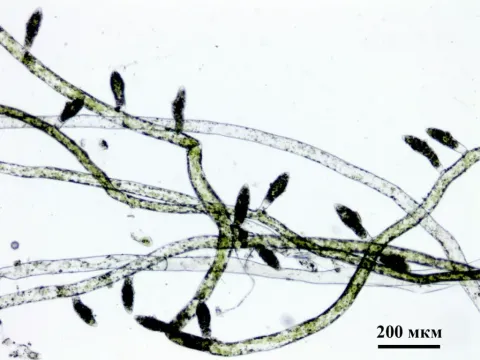
Vaucheria
Vaucheriales
The causal agent is a yellow-green filamentous alga from the order Vaucheriales. It is a free-living organism that thrives on moist substrates rather than a true parasite.
What the section contains
Vaucheria
Biologically, it consists of a non-cellular, coenocytic thallus. This giant multinucleate cell lacks cross-walls, allowing for rapid nutrient transport throughout the filament.
Vaucheria reproduces through fragmentation of its thallus, asexual reproduction via zoospores, and sexual reproduction. In agricultural conditions, fragmentation is the primary driver of rapid expansion.
While not a direct tissue pathogen, its presence significantly alters the rhizosphere and microbial balance of the soil, making it a nuisance in greenhouse production.
The organism is highly adaptable and can survive in various light conditions, though it strongly prefers wet, nutrient-rich environments often found in nursery beds.
The first sign of infestation is a velvety, bright green or emerald-colored mat forming on the soil surface within the greenhouse environment.
As the colony matures, these filaments weave into a dense, leathery crust that can cover large areas of the soil surface around plants.
On early stages, the growth appears as small, vibrant spots which rapidly coalesce into a continuous layer during periods of high humidity.
When the soil dries out, the crust becomes brittle, turns a dull brownish-gray color, and begins to crack, hindering proper soil respiration.
A distinctive, slightly swampy or musty odor is often associated with active growth, which becomes noticeable in poorly ventilated greenhouse structures.
The primary factor facilitating development is excessive soil moisture and poor drainage, which keeps the surface saturated for extended periods.
High nutrient levels, particularly an excess of nitrogen and phosphorus from fertilizers, stimulate vigorous growth of these algal colonies.
Temperatures between 18 and 25 degrees Celsius are optimal for rapid proliferation, frequently coinciding with conditions used for seedling growth.
Compacted soil surfaces and poor airflow within the greenhouse create a stable, humid microclimate that favors the establishment of the algae.
Poor sanitation, such as failing to clean irrigation equipment or pathways, allows the spores to persist and re-infest the growing area during subsequent cycles.
The crust formed by the algae acts as a barrier, physically sealing the soil and depriving the plant roots of essential oxygen, leading to suffocation.
Vaucheria competes with the crop for water and mineral nutrients, effectively robbing the plant of resources needed for vigorous development.
The breakdown of algal mats can release organic acids and other metabolites that might create a toxic environment for sensitive root tips.
By trapping moisture at the soil surface, the algae create a perfect breeding ground for damping-off pathogens and other fungal diseases.
Severe infestations reduce overall crop yield, stunt plant growth, and necessitate expensive labor for soil surface removal or repeated cultivation.
The most effective strategy is to implement precise irrigation practices, allowing the top layer of the soil to dry out between watering intervals.
Routine shallow cultivation or raking of the soil surface breaks the algal filaments and significantly improves air exchange, making the environment less hospitable.
Applying a thin layer of coarse sand or grit to the soil surface acts as a physical barrier, prevents light penetration, and discourages algal colonization.
Where infestation is heavy, copper-based fungicides or specialized algaecides may be used, provided they are safe for the specific crop variety grown.
Preventive measures include improving greenhouse ventilation, maintaining proper sanitation, and optimizing fertilization programs to avoid nutrient runoff onto the soil surface.