
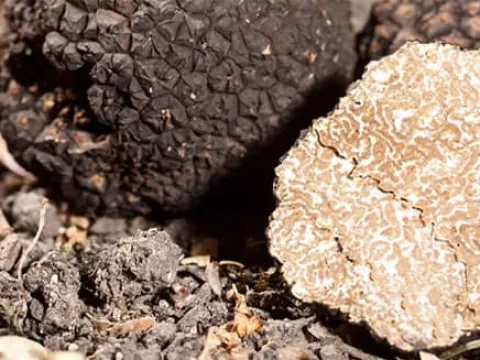
Summer truffle
Tuber aestivum
Tuber aestivum, commonly known as the summer truffle, is not a plant disease but an ascomycete fungus living in symbiosis with tree roots.
What the section contains
Summer truffle
This fungus establishes an ectomycorrhizal relationship with forest trees, aiding in nutrient and water uptake rather than damaging host plant tissues.
It is classified as a beneficial soil organism, not a phytopathogen. There is no evidence of it causing decay, wilting, or lesions on agricultural or forest crops.
The fungus produces underground fruiting bodies, which are part of its normal life cycle and do not represent a pathological manifestation.
Biologically, it is highly sensitive to soil conditions and relies heavily on tree partners, making it an indicator of ecological stability rather than a disease agent.
The most visible sign of the presence of Tuber aestivum is the formation of "brûlé" (burnt) areas, where the grass around tree trunks is inhibited.
This suppression occurs due to intense competition for water and minerals between the fungal mycelium and the surrounding grass roots.
Mature fruiting bodies are hard, dark-skinned, and warty, usually found embedded in the soil at depths of 5 to 20 centimeters.
The internal flesh of the fruit body features a white, marbled structure that darkens slightly with age, which is a key identifying morphological trait.
The distinct musky or hazelnut-like aroma is released when the spores are mature, serving as a biological signal rather than a symptom of plant decay.
Summer truffles require well-drained, alkaline, or neutral soils, rich in calcium and humus to thrive and produce successful fruiting bodies.
A specific balance of moisture is essential; while some rainfall in the summer is vital, waterlogged or excessively dry soil conditions can prove fatal to the mycelium.
Tree hosts such as oak (Quercus), beech (Fagus), and hazel (Corylus) are necessary to maintain the mycorrhizal network essential for the fungus.
Optimal temperatures for development usually fall between 15°C and 25°C, ensuring a stable environment within the topsoil layer.
Soil structure is critical; aeration is required for the fungal network to survive, so highly compacted soils will typically lead to the decline of the colony.
There is no economic harm associated with Tuber aestivum regarding crop production, as it does not parasitize agricultural plants.
In fact, it is considered a high-value biological resource. Its presence is generally welcomed by ecologists and foresters as a sign of a healthy ecosystem.
In landscaping, the suppression of grass in the root zone of host trees might be considered a disadvantage, but this is a minor issue in practice.
Since it lacks pathogenic capabilities, it does not reduce yield or quality in field crops, horticultural plants, or vegetable species.
No interventions are required to protect crops from this fungus, as it coexists harmlessly with the agricultural environment.
As Tuber aestivum is not a plant disease, no chemical control or fungicide treatments are recommended or scientifically supported.
If the suppression of grass is undesired, one can adjust the soil pH to be more acidic, which makes the environment less favorable for this species.
Mechanical disturbance or digging can disrupt the fungal network, but it does not eradicate the spores effectively if the environment remains suitable.
The use of broad-spectrum fungicides would be highly detrimental to the soil's natural health and is not a suggested method for managing this fungus.
Effective management is essentially non-existent because the fungus poses no threat to agriculture; therefore, preservation or coexistence is the standard approach.