
Sunflower diaporthe stem canker
Diaporthe sterilis
Description
Symptoms
Initial symptoms are usually observed during the flowering stage. Small, dark brown necrotic spots appear on the leaves, which expand rapidly, leading to the wilting and eventual death of the entire leaf.
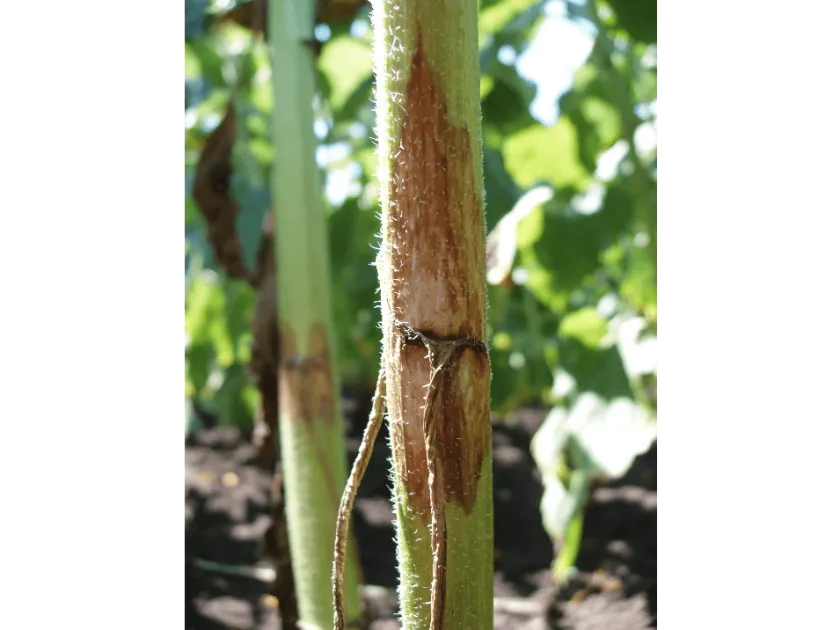
The infection progresses from the leaf petiole to the stem, where it forms large, gray-brown lesions with ill-defined borders. These lesions often cause the stem to become brittle and prone to breaking.
Inside the infected stem, the pith decomposes and becomes necrotic, losing its structural strength. In many cases, the outer bark of the stem cracks in the infected area as the fungus continues to feed on the tissue.
Heads of infected plants often fail to develop properly, resulting in small, shriveled, and low-quality seeds. Under high humidity, a light-colored mycelial growth may appear on the stem surface.
The most devastating visual sign is the sudden lodging or collapse of mature sunflowers, which happens when the weakened stems can no longer support the weight of the head.
Pathogen
The causative agent of the disease is the ascomycete fungus Diaporthe sterilis (formerly identified as Phomopsis helianthi). It is a specialized pathogen that infects sunflower crops globally.
The pathogen survives primarily in crop residues left in the field and within the soil. It produces both asexual spores (conidia) and sexual spores (ascospores), which are spread by wind and rain splashes.
Infection typically begins when spores land on the lower leaves of the sunflower. Once the pathogen establishes itself on the leaf, it grows through the petiole and eventually invades the main stem of the plant.
During colonization, the fungus secretes phytotoxins that weaken the plant's structural integrity and disrupt essential physiological processes, including nutrient transport and water uptake.
Diaporthe sterilis thrives in diverse environments but requires sufficient moisture for sporulation and infection. It remains dormant within dry plant debris until suitable weather conditions allow it to reactivate.
Conditions for development
High humidity and moderate to warm temperatures are the primary drivers of disease outbreaks. The fungus spreads most aggressively during periods of frequent rainfall during the flowering phase.
Optimal temperatures for spore germination and mycelial growth range between 20°C and 25°C. Rapid development occurs when these temperature conditions align with extended wet periods.
Dense planting configurations create a stagnant microclimate within the canopy, which increases humidity levels and significantly facilitates the spread of spores from one plant to another.
The presence of infected sunflower stubble from previous harvests is the primary source of primary inoculum. Proper management of these residues is crucial to limit the impact of the disease.
Short crop rotation cycles, where sunflowers are grown too frequently on the same land, lead to a high accumulation of fungal spores in the soil, raising the risk of severe epidemics.
Why it matters
Diaporthe stem canker is one of the most destructive diseases for sunflower production, potentially causing yield losses of up to 50% in severe infection scenarios.
The pathogen severely impairs the plant's vascular system, preventing the head from filling with high-quality kernels. This results in significant losses in total grain weight and seed size.
Beyond quantity, oil quality is also degraded. The stress induced by the fungal toxins reduces the oil accumulation process, leading to a lower overall oil percentage in the seeds.
Stem breakage causes significant field losses. When sunflowers collapse, mechanized harvesting becomes inefficient as combines may miss the fallen heads, leaving substantial portions of the crop in the field.
In addition to direct losses, farmers face increased costs associated with applying fungicides and managing infected fields to prevent future outbreaks on the same farm.
Protection
Crop rotation is the most effective long-term management strategy. A rotation cycle of at least 7-8 years between sunflower crops is recommended to reduce the survival of the fungus in the soil.
Choosing resistant or tolerant sunflower hybrids is essential. Modern breeding programs offer various options that can limit the development of stem canker infections.
Deep plowing after harvest helps bury infected plant debris, which accelerates the decomposition of plant material and reduces the fungal inoculum level for the next season.
Fungicide applications, specifically targeting the early flowering phase, can help manage the disease if the risk of infection is identified early in the growing season.
- Use certified, fungicide-treated seeds to ensure healthy germination.
- Implement rigorous weed control to eliminate alternative hosts for the pathogen.
- Maintain optimal plant spacing to promote airflow and reduce canopy humidity.
- Ensure timely harvesting to avoid exposure to prolonged wet weather during senescence.
Discussion
No discussions yet — be the first.