
Sunflower powdery mildew
Erysiphe ljubarskii
Description
Symptoms
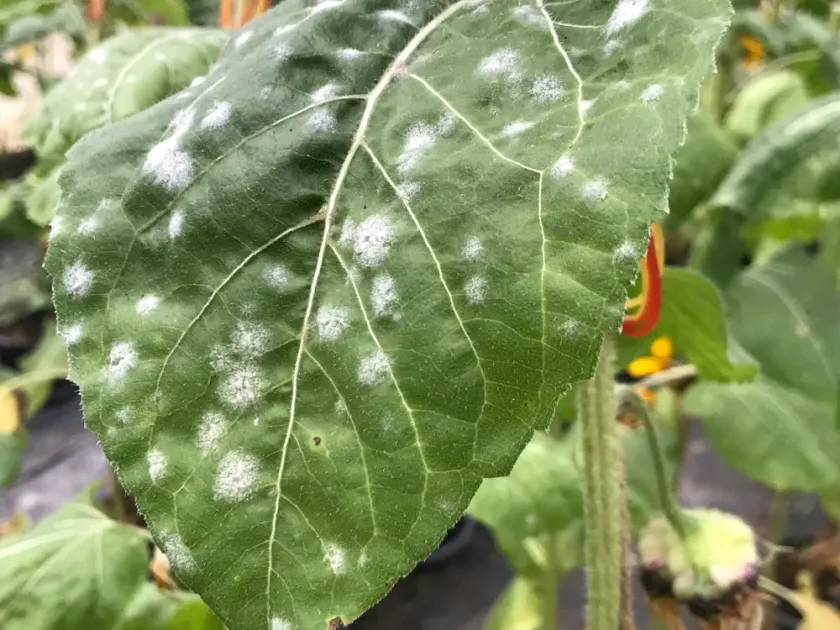
The earliest signs of infection include the appearance of white, web-like mycelial patches on the underside of lower leaves. As the infection progresses, these patches coalesce and form a dense, flour-like dust covering the leaf surface.
Affected tissues beneath the fungal mat gradually lose their chlorophyll, turning yellow, and eventually brown as the cells undergo necrosis. Leaf curling and premature senescence are common outcomes.
The fungus can spread to stems, petioles, and the back of the sunflower heads. In severe cases, the entire plant can look as if it has been coated with a layer of white or greyish dust.
Small, dark spots representing the development of cleistothecia may appear on the white mycelium in the late stages of the disease. These indicate that the fungus is preparing for its overwintering phase.
- White powdery spots on leaves.
- Leaf yellowing and tissue necrosis.
- Premature leaf drop starting from the base.
- Deformation of stems and sunflower heads.
- Visible black specks (cleistothecia) on the mycelium.
Pathogen
The causative agent of this disease is the obligate parasitic fungus Erysiphe cichoracearum, often identified in literature as Erysiphe ljubarskii. This ascomycete fungus specializes in infecting the aerial parts of plants.
The fungus develops a superficial mycelium that anchors itself into host cells using haustoria. These specialized organs penetrate the plant epidermis to absorb nutrients directly from the sunflower cells.
The pathogen overwinters primarily in the form of cleistothecia (fruiting bodies) found on infected crop residues. These structures allow the fungus to survive harsh winter conditions in the soil or field debris.
Spore production is continuous throughout the growing season. Conidia are spread by wind to healthy plants, allowing the infection to develop rapidly across entire fields during favorable weather.
This fungus is highly adapted to the sunflower host, which allows it to maintain its lifecycle even in regions with moderate agricultural practices if the initial inoculum is present.
Conditions for development
Powdery mildew thrives in warm and moderately humid conditions. The optimal temperature for rapid fungal growth and spore germination typically ranges between +20°C and +25°C.
High humidity levels and the presence of dew promote the infection process. However, unlike downy mildew, this fungus can remain active and spread even under relatively dry environmental conditions.
Dense plant populations limit airflow, creating a localized high-humidity microclimate within the canopy. This environment significantly increases the speed of disease spread between plants.
Over-fertilization with nitrogen can exacerbate the disease. Rapid growth leads to softer plant tissues that are more susceptible to penetration by the fungal haustoria.
Poor crop rotation practices contribute to the build-up of fungal inoculum in the field, leading to higher disease pressure in subsequent sunflower growing seasons.
Why it matters
The primary impact of the disease is the reduction of the photosynthetic surface area. By destroying the leaves, the fungus starves the plant of energy required for seed filling.
This leads to a significant decrease in the 1000-seed weight and overall oil content. Yield losses can be substantial, often ranging from 15% to 30% in untreated fields.
Plants weakened by the disease exhibit stunted growth and are more prone to lodging under stress. Furthermore, infected sunflowers are more susceptible to secondary infections by other pathogens.
The economic harm extends to the cost of fungicide applications and potential downgrading of grain quality. High levels of infection can make the crop difficult and inefficient to harvest.
If the infection occurs during the early reproductive stages, the damage to the sunflower head architecture can lead to poorly filled or underdeveloped seeds, further impacting profitability.
Protection
Effective crop rotation is the most critical cultural practice. A minimum of 5 to 7 years between sunflower crops is recommended to reduce the soil-borne inoculum level.
Deep plowing during land preparation helps bury infected plant residues, which prevents spores from reaching the surface and infecting the next season's crop.
Sanitation practices, including the removal of volunteer sunflowers and weeds from the Asteraceae family, are essential to break the pathogen's lifecycle and reservoir chain.
Chemical control involves the use of fungicides, specifically those containing triazoles or strobilurins. Timely application at the first appearance of symptoms is crucial for preventing widespread infection.
Selecting and planting genetically resistant sunflower hybrids is the most sustainable and efficient strategy to avoid damage from powdery mildew and reduce the need for chemical intervention.
Discussion
No discussions yet — be the first.