
Downy mildew
Peronosporaceae
Description
Symptoms
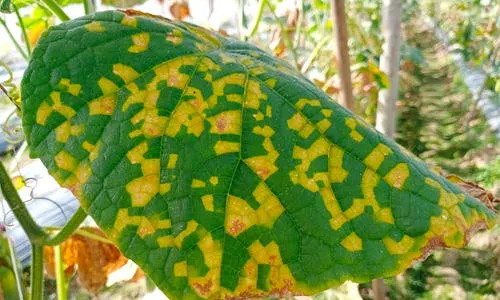
The primary symptom is the development of chlorotic or pale yellow spots on the upper leaf surface. These spots are often delineated by leaf veins, giving them an angular or mosaic appearance.
Under conditions of high humidity, a distinct downy-like growth forms on the underside of the leaves. The color of this fungal-like mat can range from white and gray to purple, depending on the specific pathogen and host.
As the infection progresses, the chlorotic spots become necrotic, turning brown and brittle. This tissue death can lead to leaf curling, premature senescence, and leaf drop, significantly reducing the foliage.
In some plants, such as onions, the infection causes the distortion and yellowing of the foliage, known as "tip burn," which can eventually lead to the collapse of the entire plant canopy.
- Chlorotic angular patches on leaves.
- Visible fuzzy growth on leaf undersides.
- Leaf curling and premature necrosis.
- Stunted plant growth and development.
- Reduced yield and poor fruit quality.
Pathogen
Downy mildew is caused by a group of obligate plant pathogens known as oomycetes, belonging to the family Peronosporaceae. These pathogens obtain their nutrition from living host tissues using specialized structures called haustoria.
The disease cycle involves the production of sporangia, which are dispersed by wind and water splash. In addition, these pathogens produce oospores, which act as long-term survival structures in the soil and crop debris.
The mycelium colonizes the intercellular spaces of plant leaves, eventually emerging through stomata to form reproductive structures. This characteristic emergence creates the visible fuzzy growth on the underside of leaves.
These pathogens are highly host-specific, meaning each strain typically targets a narrow range of plant species. Common crops affected include grapes, onions, cucumbers, lettuce, and sunflowers.
Due to the evolutionary pressure, many downy mildew pathogens have developed numerous physiological races, making the task of breeding resistant plant cultivars a continuous challenge.
Conditions for development
Downy mildew thrives in environments with high relative humidity, generally exceeding 85%. Free moisture on the leaf surface, such as dew or rain, is critical for the germination of spores.
Cool to moderate temperatures, typically between 15°C and 22°C (59°F–72°F), provide the optimal range for rapid disease development. Fluctuating temperatures and misty mornings are classic indicators of potential outbreaks.
Poor ventilation, whether in field settings or greenhouse environments, creates a localized microclimate that traps moisture and facilitates the rapid spread of the pathogen between neighboring plants.
Densely planted crops often suffer more severe infections because the canopy limits airflow and retains leaf wetness for extended periods, allowing spores more time to infect the host tissue.
Low light levels and excessive nitrogen fertilizer can make plant tissue more succulent and susceptible, thereby accelerating the colonization rate of the oomycete.
Why it matters
The infection severely compromises the photosynthetic capacity of the plant by destroying leaf area, which inevitably leads to a decline in overall plant vigor and carbohydrate storage.
Yield losses can be catastrophic, often ranging from 30% to over 70% in susceptible cultivars if environmental conditions favor the pathogen throughout the entire growing season.
Marketability of the produce is heavily impacted, as cosmetic damage, rot, and decay render fruits or vegetables unsuitable for sale or long-term storage.
In seed crops, downy mildew can directly infect reproductive tissues, resulting in reduced seed set, poor seed germination, and a higher risk of transmitting the disease to the next generation.
Economic impact is exacerbated by the high costs associated with repeated fungicide applications, which are often necessary to keep the disease in check during wet, favorable years.
Protection
Integrated disease management begins with cultural practices, such as choosing resistant cultivars and maintaining strict crop rotation to reduce the inoculum levels in the soil.
Sanitation is vital; removing and disposing of diseased plant materials prevents the buildup of oospores that could serve as a source of infection in subsequent planting seasons.
Chemical control involving systemic and contact fungicides is a primary tool for commercial growers. Proper timing and alternating modes of action are essential to prevent the development of resistant strains.
In protected cultivation, growers should prioritize climate control systems, such as improved airflow and heating, to minimize the duration of leaf wetness and suppress spore formation.
Biocontrol agents and specific amendments that boost plant systemic acquired resistance are increasingly utilized as sustainable alternatives or complements to traditional chemical fungicides.
Discussion
No discussions yet — be the first.