
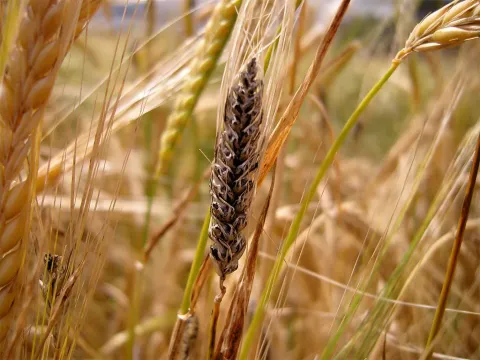
Bunt of bentgrass
Tilletia decipiens
The causal agent of this disease is the basidiomycete fungus Tilletia decipiens, which is a specialized parasite primarily affecting grass species of the genus Agrostis (bentgrass). It belongs to the group of smut fungi known for attacking reproductive tissues.
What the section contains
Bunt of bentgrass
The infection persists through teliospores that remain viable in the soil or on the surface of seeds for extended periods. These spores are the primary source of inoculation during the germination phase of the host plant.
Upon favorable conditions, the spores germinate to produce basidia and basidiospores. The resulting infection hyphae penetrate the young seedlings before they emerge from the soil, establishing a systemic infection.
The fungal mycelium develops internally throughout the plant stem, colonizing the host without showing visible symptoms until the flowering stage. The pathogen gradually concentrates its growth in the ovaries.
As the plant matures, the internal contents of the ovaries are replaced by a dark mass of spores. The mycelium disintegrates, leaving behind a hard smut ball composed of millions of teliospores protected by the floral glumes.
Visible symptoms typically appear only during the heading or anthesis stage. Infected plants may appear slightly stunted, but they often resemble healthy plants until the panicles develop fully.
The primary symptom is the transformation of seeds into smut balls. The floral structures become swollen as the interior space is completely filled with a dense, black, powdery mass of fungal spores instead of a healthy grain.
Panicles of infected plants often appear deformed or more compact than normal. The floral glumes may be splayed or distorted by the pressure of the accumulating spore mass within the ovary.
Upon maturation, the outer membrane of the smut ball remains relatively firm, but it is easily ruptured by physical contact during harvest, releasing the characteristic dark, soot-like spores.
The presence of these smutted heads creates a distinct visual difference in the field, especially when the spores begin to disperse, covering surrounding tissues and neighboring plants in a black dust.
The development of bentgrass bunt is heavily dependent on weather conditions at the time of planting. Moderate temperatures that slow down seedling emergence significantly increase the window for infection.
High soil moisture during the germination period is critical for the activation of Tilletia decipiens spores. Moist conditions promote the germination of spores and the successful penetration of the young, vulnerable seedling tissues.
High planting density contributes to a microclimate that favors infection. Poor air circulation within dense stands maintains the humidity levels necessary for spore germination and secondary pathogen spread.
Soil pH and fertility levels can influence the pathogen's activity, though the fungus is highly adapted to the standard growth requirements of bentgrass. Consequently, cultural management remains the most effective tool.
Continuous cropping of bentgrass on the same field leads to the progressive accumulation of teliospores in the soil. Without adequate rotation, the disease pressure increases significantly with each subsequent season.
The primary economic impact of the disease is the direct loss of seed yield. Since the pathogen destroys the ovaries, the plant fails to produce viable seeds, rendering the crop useless for commercial distribution.
The dispersal of spores during harvest contaminates the entire seed lot. Such contaminated seed is highly ineffective and poses a major risk of spreading the disease to new, previously clean areas.
Bentgrass bunt reduces the overall vigor and productivity of forage stands. Chronic infection leads to thinning of the turf, which ultimately reduces the biomass available for livestock grazing.
Financial losses also accrue from the need for specialized cleaning and fungicide treatment of seed lots, as well as the potential necessity for soil disinfection treatments in severe cases.
The release of spores into the air during harvest operations creates a health hazard for workers, potentially causing respiratory issues, and creates logistical challenges for storage due to spore-contaminated dust.
The most crucial step in management is the use of disease-free, certified seed. Strict laboratory testing of seed batches to identify and eliminate any presence of teliospores is standard practice.
Seed treatment with systemic fungicides prior to sowing is highly effective. This protects the emerging seedlings from both seed-borne and soil-borne inoculum during the critical germination phase.
Adherence to a well-planned crop rotation is essential to break the pathogen's life cycle. Rotating with non-host species allows for the natural decay and reduction of teliospore populations in the soil over time.
Effective management includes the removal of wild grass species that may act as alternative hosts or reservoirs for the fungus, thereby reducing the local inoculum pressure.
Optimizing planting dates and ensuring proper soil drainage can help ensure rapid seedling establishment, effectively shortening the period during which the plant is most susceptible to infection.