
Bull Kelp
Durvillea antarctica
It must be clarified that Durvillea antarctica, commonly known as Bull Kelp, is not a plant disease or a pathogen. It is a large, edible brown alga that plays a vital role as a primary producer in marine coastal ecosystems.
What the section contains
Bull Kelp
Categorizing this seaweed as a plant disease is a scientific inaccuracy. It poses no threat to terrestrial crops, agricultural plants, or forestry, as it is strictly a marine organism.
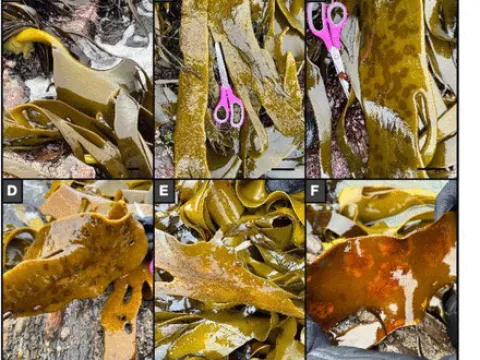
The organism is characterized by a thick, leathery, and honeycomb-like tissue structure. This allows it to withstand extreme hydraulic forces found in high-energy rocky intertidal zones.
Unlike pathogenic fungi or bacteria, Bull Kelp does not invade host tissues or cause necrosis in terrestrial vegetation. Its ecological function is to provide shelter and nutrition for various marine fauna.
From an agricultural standpoint, there are no control measures or defensive strategies required for this species, as it is naturally confined to its marine environment.
The development of Durvillea antarctica is entirely dependent on cool, nutrient-rich coastal waters. It thrives in regions characterized by heavy wave action and persistent ocean currents.
This alga attaches itself firmly to rocky substrates. It requires high light intensity to support its rapid growth, typically found in the intertidal and shallow subtidal zones.
Distribution is limited to the Southern Hemisphere, including coastlines of New Zealand, Chile, and various sub-Antarctic islands. Cold temperature is essential for its life cycle.
Reproductive success is linked to the release of zoospores, which disperse through ocean currents. The ability to colonize new rocks depends on the availability of clean, stable surfaces.
The physical resilience of the plant is aided by the flexibility of its stipe and blade, preventing it from being dislodged during severe storms or high-tide surges.