
Bull's eye rot
Neofabraea malicorticis
The disease is caused by the fungus Neofabraea malicorticis, also recognized in some scientific literature under the name Pezicula malicorticis.
What the section contains
Bull's eye rot
This fungal pathogen is primarily responsible for bark lesions and post-harvest fruit decay in apple and pear trees.
The fungus overwinters as mycelium in the infected bark tissues or as fruiting bodies (apothecia) on dead branches and twig cankers.
During wet weather, spores are released and dispersed by rain splash and wind, infecting healthy fruit and bark surfaces nearby.
It is a slow-growing pathogen, which often results in latent infections where symptoms do not become visible until the fruit is in storage.
On branches, the infection manifests as depressed, circular, or elliptical lesions on the bark, often leading to the formation of cankers.
Over time, the center of these lesions may develop small, light-colored fruiting bodies that break through the surface of the bark.
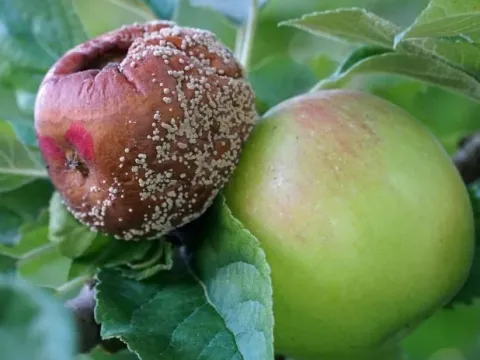
On the fruit, the initial symptoms appear as small, firm, brown circular spots that gradually become sunken.
As the rot progresses, concentric rings of fungal growth often develop within the lesion, giving the appearance of a "bull's eye".
- Sunken necrotic lesions on twigs and branches.
- Canker development leading to dieback of limbs.
- Brown, sunken circular fruit rot spots.
- Concentric ring patterns on decaying apple surfaces.
- Presence of creamy white fungal sporulation on infected tissue.
The development of Bull's eye rot is highly dependent on high humidity and cool to moderate temperatures, especially during the harvest season.
Prolonged rainfall events during the weeks leading up to harvest provide the ideal moisture conditions for spore germination and infection.
Orchards with poor air circulation due to dense canopy growth are more prone to infection as leaves and fruit remain wet for longer periods.
Any mechanical injury to the tree bark, whether from pruning, hail, or pest damage, serves as a point of entry for the fungal spores.
Late-season rainfall is particularly risky, as it facilitates the infection of fruit just before it is picked and moved to cold storage.
The primary economic impact is significant loss of stored fruit due to decay, which is often difficult to detect during the sorting process.
Cankers on trunks and main branches can severely weaken the tree, eventually leading to the death of limbs or the entire tree if left untreated.
Infected trees serve as a persistent reservoir for the pathogen, necessitating intensive management and increased use of chemical controls.
Reduced tree vigor due to widespread bark infection makes the orchard more susceptible to secondary pests and winter damage.
The labor cost associated with constant sanitation pruning and the removal of infected wood adds significant expense to orchard operations.
The most effective strategy involves strict sanitation measures, including the regular removal and burning of all canker-infected branches.
Applying protective fungicides during the pre-harvest period and following leaf drop can significantly reduce the potential for new infections.
Proper orchard management, including thinning the canopy to improve light and airflow, is essential to minimize the time moisture remains on the fruit surface.
All pruning wounds should be treated promptly with appropriate sealants to prevent the opportunistic colonization by fungal spores.
Ensuring that fruit is harvested during dry conditions and cooled rapidly after storage helps to mitigate the development of latent rot infections.