
Bull's eye rot
Neofabraea perennans
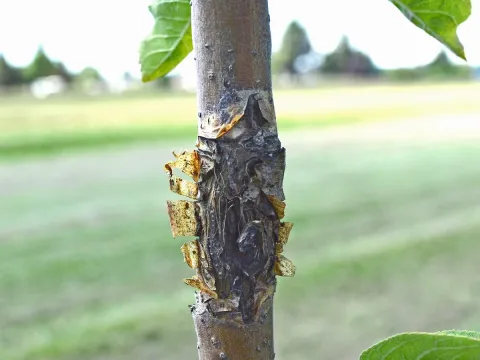
The disease is caused by the fungus Neofabraea perennans, which is also responsible for forming perennial cankers on the bark of fruit trees.
What the section contains
Bull's eye rot
It is a fungal pathogen that targets both the vegetative parts of the tree and the ripening fruit, posing a significant threat to commercial orchards.
The fungus reproduces by forming conidia in bark cankers, which are then disseminated by rain splashes and wind to healthy plant tissues.
The pathogen can persist in the orchard within infected wood for many years, acting as a constant reservoir of infection.
While primarily affecting apple trees, it can also infect pears, requiring an integrated monitoring approach for all pome fruits.
On fruit, the disease manifests as small, slightly sunken circular lesions that are light brown or tan in color.
Under humid conditions, small white or cream-colored pustules, representing the fungus's spore-bearing structures, may appear in the center of the lesions.
The flesh beneath the rot spots becomes soft, develops a bitter taste, and emits a distinct odor, rendering the fruit commercially unmarketable.
On the branches of infected trees, specific cankers with concentric rings are often found, typically surrounding old wounds or branch stubs.
Symptoms on the fruit are frequently latent, meaning they are often invisible at harvest and only develop during cold storage.
The development of the fungus is favored by cool and wet weather conditions during the latter part of the growing season, particularly near harvest time.
High humidity within the tree canopy, resulting from poor pruning or dense foliage, accelerates the infection of developing fruit.
Extended periods of dew or frequent rainfall facilitate the dispersal of spores from bark cankers to healthy fruit surfaces.
Cultural practices that lead to vigorous, lush growth, such as excessive nitrogen fertilization, can make fruit more susceptible to infection.
Storing fruit at temperatures above the recommended range significantly speeds up the progression of latent infections acquired in the orchard.
The primary economic damage occurs during post-harvest storage, leading to substantial losses in marketable yield.
The rot ruins the appearance and quality of the fruit, making it unsuitable for fresh market sale or long-distance transport.
Severe infection of the branches results in canker development, which weakens the tree and can eventually lead to branch dieback or tree death.
Because the infection is often latent, growers may experience significant financial losses after fruit has already been packed and placed in storage.
Managing the disease requires increased labor for sorting and discarding infected produce, which raises overall production costs.
Effective management begins with strict sanitation, including the pruning and removal of branches showing signs of canker infection.
Regular fungicide applications during the growing season, especially in late summer, are essential to protect the fruit from infection.
Harvesting fruit at the proper maturity stage and avoiding over-ripeness can help reduce the susceptibility of the fruit to the pathogen.
Maintaining optimal temperature and humidity levels in cold storage facilities is crucial for minimizing the development of latent rot.
- Planting cultivars that exhibit genetic resistance to bark and fruit diseases.
- Sanitizing pruning tools after working on infected trees to prevent cross-contamination.
- Implementing balanced fertilization programs to keep trees healthy and less prone to infection.