
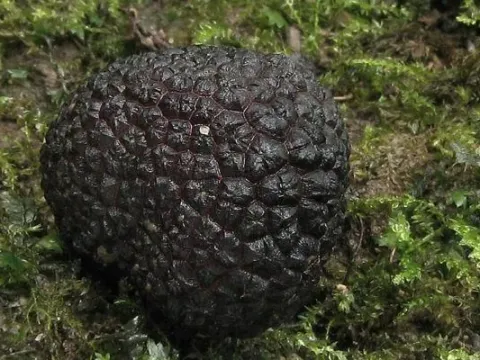
Burgundy truffle
Tuber uncinatum
The Burgundy truffle, scientifically known as Tuber uncinatum, is an ascomycete fungus within the Tuberaceae family. Biologically, it is not a traditional pathogen, but rather a symbiotic mycorrhizal fungus that forms ectomycorrhizae with host trees.
What the section contains
Burgundy truffle
The relationship between the fungus and the plant is defined as mutualism, where the fungus obtains carbohydrates from the host tree while providing water and essential soil nutrients in return. Agronomically, this colonization of roots is often analyzed in terms of its impact on plant physiology.
Host trees are typically broad-leaved species, such as oaks, beeches, hornbeams, and hazelnuts. The fungus integrates into the root system by forming specialized mycelial structures that facilitate the nutrient exchange process.
The life cycle involves the formation of hypogeous fruiting bodies at depths of 5 to 30 centimeters. Spore dispersal is highly dependent on wild animals that forage for these aromatic fungi, ensuring the continuation of the fungal life cycle.
The biology of Tuber uncinatum is highly specialized, making it a key biological agent that significantly alters the host tree's root environment rather than acting as a destructive plant disease.
The most prominent sign of the truffle's presence is the formation of a brûlé (burnt area) around the base of the host tree. This is an area where the dense mycelial network suppresses the growth of competitive grasses and herbs.
Microscopic examination of the root system reveals characteristic root tip swellings and the presence of fungal hyphae enveloping the roots. These changes in the root structure are essential for the symbiotic exchange.
Fruiting bodies are globose with a rough, warty peridium that turns dark brown when mature. Inside, the gleba displays a white marbling pattern against a brown background, which is a key diagnostic feature.
A distinctive, pleasant aroma resembling toasted hazelnuts and forest floor is a definitive sign of mature Burgundy truffles, which becomes more intense as the fruiting body matures under the soil.
Soil chemical analysis in the vicinity of the brûlé often reveals significant shifts in pH and nutrient concentration, reflecting the intense metabolic activity of the truffle mycelium.
Burgundy truffles thrive in calcareous soils with high calcium content and a neutral to slightly alkaline pH. High soil acidity inhibits the development of the mycelium and prevents the formation of fruiting bodies.
Moderate climatic conditions are necessary, with stable temperatures and consistent soil moisture. The presence of a tree canopy is crucial to provide shade and maintain the specific microclimate required for the fungus.
Soil aeration is a vital factor; the fungus requires oxygen-rich, well-draining soils to develop properly. Compact or waterlogged clay soils are generally unsuitable for the lifecycle of Tuber uncinatum.
The fungus is sensitive to high levels of microbial competition, so it is most successful in ecosystems with stable, balanced soil microbiota. It rarely colonizes disturbed or poorly managed soils.
Host trees aged between 10 and 30 years are the most productive, as this period corresponds with the stage when trees have sufficient surplus energy to support the symbiotic fungal partner.
While highly valued as a delicacy, the presence of the truffle in forests can limit local plant biodiversity by suppressing the growth of understory vegetation and grasses around host trees.
The ecological impact involves the restructuring of the forest floor, where the brûlé creates a barren zone that can impede natural forest regeneration for certain plant species.
In nursery settings, the presence of the fungus may be viewed as undesirable if the goal is to produce plant stock free from external mycorrhizal colonization, complicating production standards.
Extensive colonization by the truffle may compete with other native mycorrhizal fungi, potentially disrupting the long-term ecological balance of the forest ecosystem.
In intensive cultivation, prolonged growth of truffles can lead to soil depletion or "truffle fatigue," making the site less suitable for subsequent crops or other types of agricultural activities.
If the elimination of the fungus is required, the primary strategy is to lower soil pH through the application of acidifying fertilizers, which creates an unfavorable environment for Tuber uncinatum.
Systemic fungicides could theoretically be used to control the mycelium, but such interventions are strictly regulated and rarely implemented due to the risk of damaging broader soil microbial health.
In nurseries, maintaining strict sanitary protocols, including the use of sterilized soil and filtered water, is the most effective way to prevent the unintended colonization of seedlings with truffle spores.
Managing soil moisture levels to avoid saturation can naturally discourage the development of the fungus in areas where it is not desired.
Prevention involves careful monitoring of incoming planting stock for signs of mycorrhizal infection, ensuring that only certified clean material is introduced into non-truffle sites.