
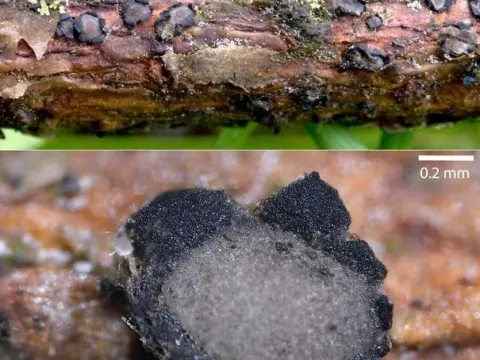
Therrya pini
Therrya pini
The primary symptom of this disease is the premature yellowing and dropping of needles on young pine shoots. In areas where the infection is localized, the needles turn brown or reddish-brown, and characteristic cracks appear on the bark.
What the section contains
Therrya pini
As the disease progresses, the fungus forms fruiting bodies called apothecia on the bark surface. These appear as small, elongated black structures that emerge through cracks in the bark, signaling the pathogen's activity.
Chronic infection leads to bark necrosis, causing the drying out of individual shoots or entire branches. A secondary sign often involves resin bleeding in the areas where the fungal fruiting bodies are present.
Infection becomes especially noticeable at the end of the growing season when the distinction between healthy and dying needles is most visually apparent. The intensity of symptoms depends heavily on the age and health status of the tree.
It is essential to differentiate these symptoms from those caused by other fungal pathogens, such as needle cast (Lophodermium), as Therrya pini primarily targets the bark and the base of the needles.
The pathogen responsible for the disease is the ascomycete fungus Therrya pini. It is a specialized parasite that preferentially develops on tissues of coniferous trees, primarily of the Pinus genus.
The life cycle involves the formation of ascospores, which are dispersed by wind and rain droplets over significant distances. The infection enters the tree through micro-cracks in the bark of young shoots.
The fungal mycelium develops beneath the bark, gradually penetrating the cambium layer and the wood. This disrupts the tree's normal nutrient transport, leading to the gradual death of the shoots.
The biology of the fungus is tightly synchronized with the host tree's rhythms, with active spore production occurring during periods of high humidity. The pathogen can survive for a long time on infected branches.
In addition to its sexual reproductive phase, Therrya pini can produce conidia, which facilitates the rapid spread of the infection within a forest stand or nursery setting.
Dense plantations with poor air circulation and high humidity provide ideal conditions for the development of the fungus. Moisture stagnation in the lower crown promotes spore germination.
Trees weakened by environmental stressors, such as prolonged drought or waterlogging, are significantly more susceptible to the disease. Mechanical bark damage also serves as a critical entry point for the fungus.
Temperatures ranging from 15 to 20 degrees Celsius, combined with high relative humidity, create the optimal environment for the rapid germination of Therrya pini ascospores.
Low light levels deep within the canopy slow the evaporation of moisture from needle and bark surfaces, making these interior branches particularly vulnerable to initial infection.
The failure to perform sanitary pruning and the accumulation of dead wood (standing dead trees) create a persistent source of infection, maintaining high spore pressure throughout the area.
The main threat is the weakening of young trees, which often leads to mortality in nurseries and young forest plantations. Older trees suffer from reduced annual growth rates.
Massive shoot infection causes crown deformation and loss of aesthetic value, which is particularly critical for ornamental or urban pine plantings. Necrosis development reduces the tree's overall resilience.
Disruption of physiological processes in the branches makes trees more susceptible to secondary colonization by wood-boring insects, such as bark beetles and longhorn beetles.
In nursery management, the disease can lead to the rejection of a significant percentage of planting stock, resulting in serious economic losses for the forestry industry.
If the infection source is not managed in time, the disease spreads rapidly to neighboring trees, gradually suppressing the entire plant from the lower crown upwards.
The primary control method involves sanitary practices: the removal and immediate burning of heavily infected branches and dead trees to lower the overall inoculum pressure.
In nurseries, it is recommended to maintain optimal planting density to ensure proper canopy aeration. Maintaining a high level of silvicultural care is crucial for plant vigor.
Systemic fungicides are effective during the early stages of the disease. Treatments should be scheduled during periods of active fungal sporulation, adhering strictly to protective protocols.
Preventive treatment of seedlings with copper-based fungicides helps establish a protective barrier against the entry of fungal spores into the soft tissues of young pine shoots.
Regular monitoring of forest stands allows for the identification of primary infection centers before the fungus reaches peak sporulation, significantly increasing the effectiveness of control efforts.