
Thielaviopsis
Thielavia
Description
Symptoms
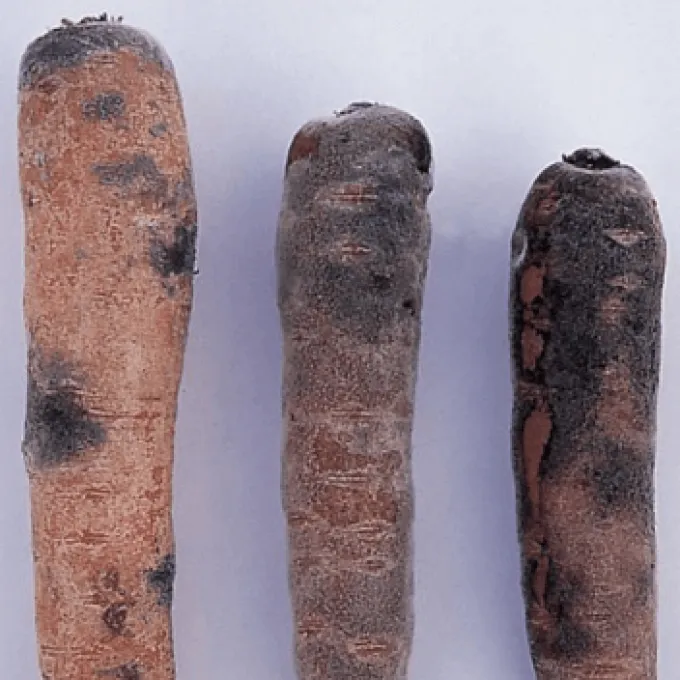
The most distinctive symptom of this disease is the blackening of the roots, which is why it is commonly referred to as black root rot.
Above-ground symptoms often include stunted growth, chlorosis, and wilting, especially during hot periods when the root system fails to compensate for water loss.
Upon examination, the roots display dark necrotic lesions. In advanced stages, the outer cortex of the root sloughs off, leaving behind a brittle and darkened central stele.
Affected seedlings may die shortly after emergence, while mature plants show poor vigor, reduced leaf size, and significant yield loss.
A microscopic examination or laboratory culture is often required for precise diagnosis, as symptoms can be confused with other root rotting organisms.
Pathogen
Thielaviopsis is caused by the fungus Thielavia basicola, also known as Berkeleyomyces basicola. It is a persistent soil-borne pathogen capable of surviving in the soil for several years.
The pathogen infects a wide range of host plants by attacking the root system. It thrives in various environmental conditions, using its resting spores to survive periods without a suitable host plant.
The fungus produces two types of spores: endoconidia for rapid spread and thick-walled chlamydospores that provide long-term survival in the soil environment.
Infection primarily occurs through root tips and hairs, spreading rapidly within the plant tissues and causing significant damage to the plant's ability to uptake water and nutrients.
The fungus is highly contagious and can be easily transferred through contaminated equipment, irrigation water, soil particles, and infected nursery stock.
Conditions for development
The development of Thielaviopsis is favored by cool to moderate soil temperatures, typically ranging from 15°C to 22°C, which is common in early spring or greenhouses.
Excessive soil moisture and poor drainage create the ideal environment for the spores to germinate and infect the host roots effectively.
The fungus prefers neutral to alkaline soil pH levels. High pH levels are known to significantly promote the activity and spread of the pathogen in agricultural fields.
High planting density and poor airflow in closed environments significantly increase the risk of an outbreak, as the fungus spreads through moisture and touch.
Stressful conditions for the plant, such as improper fertilization or temperature fluctuations, make them highly susceptible to Thielaviopsis infections.
Why it matters
The primary harm caused by Thielaviopsis is the significant reduction in crop yield and quality. In greenhouses, it can destroy entire batches of seedlings.
The disease causes substantial economic losses by necessitating the replacement of contaminated soil and the disposal of infected plants, which cannot be cured once the root system is severely damaged.
The persistence of the pathogen in the soil means that growers are restricted in their crop selection for many years to come.
Widespread infection can lead to complete field failure, especially in susceptible monocultures where the pathogen has had sufficient time to build up in the soil.
The cumulative effect of poor growth and plant mortality significantly impacts the overall profitability of farming operations, especially for high-value ornamental and vegetable crops.
Protection
Crop rotation is the most effective cultural practice to manage the pathogen. Avoiding susceptible hosts for at least 3-4 years helps reduce the inoculum level in the soil.
Maintaining soil pH in the slightly acidic range can suppress the fungus, as it performs poorly in more acidic conditions compared to neutral or alkaline soil.
Utilizing clean, disease-free nursery stock and implementing strict sanitation protocols for greenhouse equipment are essential to prevent introducing the pathogen.
Biological controls, particularly using Trichoderma species, have shown success in suppressing Thielaviopsis in soil and organic growing media.
- Ensure good drainage to prevent water stagnation.
- Apply fungicides only when necessary and as part of an integrated management program.
- Remove and destroy all infected plant material promptly.
- Monitor environmental conditions in greenhouses to prevent cool, damp microclimates.
Discussion
No discussions yet — be the first.