
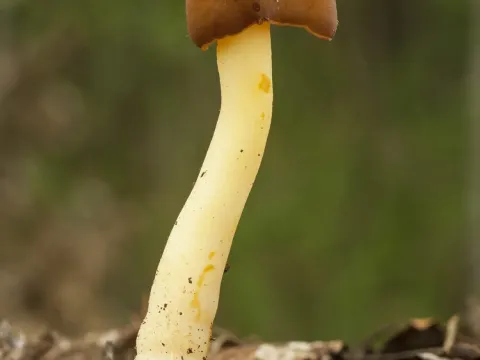
Thimble Morel
Verpa conica
Verpa conica, commonly known as the Thimble Morel, is an ascomycete fungus belonging to the Morchellaceae family. It is crucial to note that this fungus is not a plant pathogen or a crop disease.
What the section contains
Thimble Morel
Operating as a saprotroph, the fungus plays an ecological role in breaking down organic matter within forest soil. It does not infect plants, nor does it cause any agricultural damage to crops.
The fruiting body consists of a thimble-shaped cap and a hollow, whitish stalk. The cap is distinctively attached to the stem only at the very apex, which serves as a key diagnostic feature.
Spore production occurs within asci located on the surface of the cap. These spores are dispersed by wind currents during the spring season when the environmental conditions favor reproduction.
Unlike parasitic fungi that disrupt plant physiology, Verpa conica is an indicator of a healthy forest soil ecosystem. It operates entirely independently of cultivated plant health.
Thimble Morels thrive in moist, well-drained soils rich in humus. They are primarily found in deciduous and mixed forests, often emerging from leaf litter in early spring.
The optimal development period ranges from mid-April to early May. Warm temperatures combined with steady spring moisture are essential for the maturation of the fruiting bodies.
They are frequently associated with specific deciduous trees, such as aspens and alders. These mushrooms prefer undisturbed sites where the soil structure remains intact and nutrient-dense.
Environmental fluctuations significantly affect their appearance. Periods of drought during the early spring can prevent the fruiting bodies from developing, even if the mycelium is thriving.
The presence of Verpa conica is usually restricted to areas with minimal human interference. They avoid highly polluted soils, making them sensitive indicators of local environmental quality.