
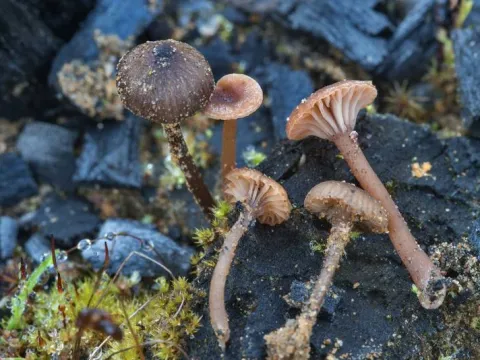
Tephrocybe atrata
Tephrocybe atrata
Tephrocybe atrata is a saprotrophic fungus belonging to the Lyophyllaceae family, often mistakenly labeled as a plant disease in general contexts.
What the section contains
Tephrocybe atrata
In reality, this fungus is a soil-inhabiting organism that feeds on organic matter and does not possess any parasitic traits against plants.
It is not a pathogen and does not cause infections in agricultural, horticultural, or silvicultural crop species.
This fungus is classified as carbonicolous, meaning it specializes in decomposing substrates that have been subjected to high heat, such as wood ash.
From a plant pathology perspective, Tephrocybe atrata poses no threat to agribusiness and requires no management or control strategies.
The fruiting bodies of this fungus are identifiable by their specific appearance, usually found directly on old fire sites.
The cap is small, typically 1 to 4 centimeters in diameter, and exhibits dark gray or blackish coloration.
The gills underneath are sparse and broad, appearing grayish or whitish, which provides a striking contrast to the darker cap.
The stem is fragile and slender, often matching the color of the cap, and lacks any distinct ring or veil structures.
The presence of this fungus is a biological indicator of the presence of charred wood or charcoal remnants in the soil profile.
The primary prerequisite for the growth of this species is the availability of burnt substrate, such as old campfires or controlled burn sites.
The fungus thrives in areas where the soil has been heated, which temporarily reduces competition from other soil microflora.
The ideal period for fruit body development ranges from late spring to autumn, provided there is sufficient moisture in the substrate.
The chemical composition and pH levels of wood ash create an environment favorable for the colonization of this specific fungus.
Spore dispersal occurs via air currents, allowing the fungus to quickly colonize new suitable sites across open fields or forest clearings.
Tephrocybe atrata is not an agricultural pest; therefore, it causes no damage to crops, yields, or soil health.
It does not infect roots, stems, or leaves, remaining entirely benign to all cultivated plant species.
In forest ecosystems, this fungus plays a beneficial role by participating in soil regeneration and the mineralization of charred organic debris.
Because there is no negative impact on plant health, there is no justification for chemical applications or other control measures.
The fungus is ecologically significant but economically neutral, as it does not compete with or affect the production of agricultural crops.
No specialized control measures are established for Tephrocybe atrata, as it is not a plant pathogen requiring management.
Preventive measures are limited to avoiding open fires on agricultural plots if the presence of such fungi is undesirable for aesthetic reasons.
To remove the fruiting bodies, simple mechanical clearing of charcoal and ash remains from the soil surface is sufficient.
The use of fungicides against this species is strongly discouraged, as it disrupts beneficial soil microbial communities without any benefit.
In summary, Tephrocybe atrata is a natural soil inhabitant that should be considered a neutral component of the ecosystem.