
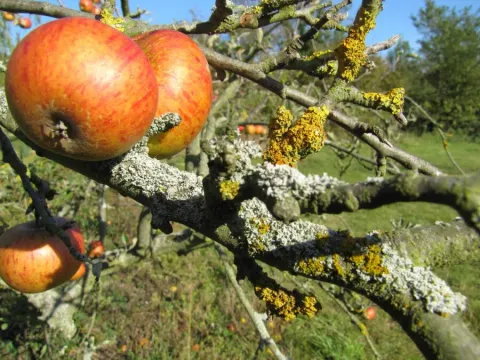
Teloschistales lichens
Teloschistales
Teloschistales lichens typically manifest as crusty or foliose patches on the bark, often displaying vibrant yellow, orange, or reddish hues due to parietin content.
What the section contains
Teloschistales lichens
They attach firmly to the surface of trunks and branches, appearing brittle and dry in sunny weather but becoming supple and bright when wet.
These organisms are most commonly found on older, mature trees where the bark is rougher and provides better anchorage for fungal hyphae.
Heavy colonization results in a textured, uneven surface on the tree trunk, often covering areas that receive the most direct sunlight.
While often mistaken for a disease, their presence is primarily a visual indicator of bark condition rather than a direct parasitic attack.
It is crucial to note that Teloschistales lichens are not pathogens; they are symbiotic organisms consisting of a fungus and an alga or cyanobacterium.
They do not invade the living tissues of the host plant, nor do they extract nutrients or sap from the tree, which distinguishes them from parasites.
The tree serves merely as a stable platform for growth, providing the necessary height and surface to access sunlight and atmospheric moisture.
They are classified as epiphytes, meaning they are biologically independent of the tree's internal metabolism, despite growing directly on it.
Therefore, treating them as a disease is agriculturally inaccurate, although their impact on the tree's external environment can be significant.
High humidity and poor air circulation are the primary factors that facilitate the establishment and spread of these lichens.
Densely planted orchards with thick, unpruned canopies create a stagnant microclimate that is highly favorable for lichen survival.
Trees with damaged or slowly growing bark are more susceptible to colonization as they provide a stable, undisturbed surface over time.
An environment with clean air is necessary, as many species within this order are highly sensitive to industrial air pollution and sulfur dioxide.
Persistent moisture on the bark surface allows the fungal components of the lichen to maintain metabolic activity throughout the growing season.
The primary concern is that dense lichen mats provide excellent shelter for various pests, such as scale insects and mites, during their overwintering stage.
Although they do not feed on the tree, thick lichen layers can restrict gas exchange through the bark lenticels, potentially stressing the tree.
They trap moisture against the bark, which may promote the development of secondary fungal rot or other moisture-loving pathogens.
Their presence often obscures the view of the bark, hiding early symptoms of genuine tree diseases like cankers, wood decay, or insect boreholes.
While not lethal, a heavy infestation often signals that the tree lacks the vigor to grow new bark layers, making it less resilient overall.
The most effective strategy is to implement regular pruning to improve air circulation and sunlight penetration throughout the canopy.
Mechanical removal using soft brushes or scrapers during the dormant season is a safe way to clean the trunk without damaging the tree cambium.
Applying a lime wash to the trunks, often enriched with copper sulfate, creates an alkaline environment that discourages lichen attachment.
Spraying the trees with ferrous sulfate solutions during the dormant period is a proven method for suppressing the growth of lichens and mosses.
Maintaining high horticultural standards, including adequate fertilization and irrigation, ensures vigorous tree growth, which naturally limits lichen expansion.