
Teloschistes
Teloschistes
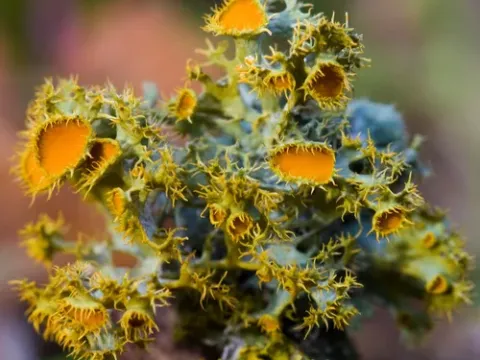
Teloschistes appears as bright orange or yellow-orange shrubby growths that adhere firmly to tree bark. Visually, the colonies look like branched thalli resembling tiny shrubs or dense beards.
What the section contains
Teloschistes
These organisms are most often found on the branches and trunks of old or weakened trees with slowed bark growth. Visually, they contrast with the gray or brown surface of the trunk.
Upon close inspection, one can notice that the surface of the lichen body is slightly rough or covered with small fruiting bodies called apothecia. They hold firmly to the substrate but do not penetrate deep into the wood tissues.
The spread of the lichen occurs gradually, starting from the northern or most shaded side of the trunk. Over time, colonies can cover a significant area of the bark surface, hindering gas exchange.
Unlike fungal pathogens, Teloschistes does not cause tissue necrosis directly; however, the presence of a thick covering changes the microclimate of the bark's surface layer.
Teloschistes is not a parasitic fungus or bacterium in the classic sense; it is a lichen — a symbiotic organism consisting of a fungus (mycobiont) and an alga (photobiont).
It belongs to the family Teloschistaceae. The main component of its bright orange color is parietin, a specific pigment that protects the organism from excessive ultraviolet radiation.
The fungal component provides attachment to the bark and retains moisture, while the algae carry out photosynthesis, providing the organism with organic substances.
This object is a typical epiphyte. It uses the tree solely as a substrate for placement, obtaining mineral nutrition from atmospheric precipitation and dust.
The biology of the organism involves extremely slow growth, allowing it to exist on the same area of tree bark for decades.
The main factor for development is high air humidity, which is necessary for the metabolism and active growth of the lichen.
Teloschistes prefers areas with good lighting, which is why it is often found in young orchards with sparse crowns or on isolated trees.
The presence of sufficient nitrogenous nutrients in the atmosphere (for example, due to proximity to farms) contributes to more intensive colony growth.
A neglected state of the garden, lack of pruning, and poor crown ventilation create ideal conditions for lichen spores to attach to the bark.
Trees with a slow rate of bark growth are more prone to colonization because spores attach more easily to old, "preserved" bark.
The main danger is that a dense layer of lichen creates a comfortable environment for the overwintering of pests, such as scale insects, soft scales, and mites.
Covering the bark with a dense layer prevents the tree from breathing properly, which can slow down vital processes in the cambium.
Lichen can retain excess moisture on the bark surface, which contributes to the development of secondary rot processes in wood micro-cracks.
In orchards with high lichen colony density, premature tree aging and reduced productivity are often observed due to general plant depression.
Although the lichen does not feed on the tree's sap, it signals to the agronomist that the orchard needs attention, such as rejuvenating pruning or improved fertilization.
The primary measure is mechanical cleaning of trunks and skeletal branches with scrapers or brushes during the dormant period when the wood is damp.
After cleaning, it is recommended to whitewash the trunks with a lime solution containing copper sulfate, which prevents the re-attachment of spores.
Regular sanitary and rejuvenating pruning helps improve crown ventilation and reduces humidity, making the environment unsuitable for lichen.
For chemical protection, spraying with a 3-5% solution of iron sulfate is used, which effectively suppresses the growth of lichen colonies.
- Regular crown pruning
- Mechanical removal of growths
- Whitewashing with lime milk
- Balanced tree fertilization