
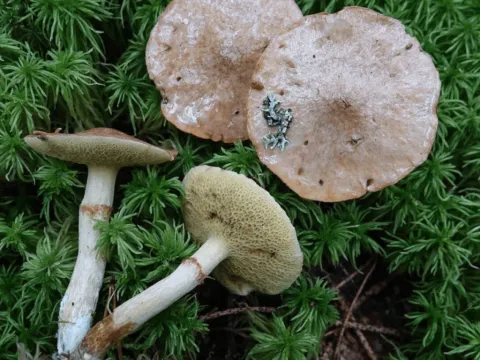
Suillus flavidus
Suillus flavidus
Suillus flavidus, commonly known as the yellow bog bolete, is not a plant pathogen or a disease-causing agent.
What the section contains
Suillus flavidus
It is a strictly mycorrhizal fungus that forms symbiotic relationships with the roots of certain conifers, particularly in wet environments.
In agricultural and silvicultural terminology, it should be categorized as a beneficial organism rather than a disease.
The fungus provides the host plant with water and mineral nutrients, significantly enhancing the tree's health in nutrient-poor, acidic, and boggy soils.
Its presence is a sign of a healthy, symbiotic relationship, rather than a sign of pathological distress to the vegetation.
The fruit bodies are characterized by a sticky, yellow to ochre cap that is typical of the Suillus genus.
Young specimens display a partial veil that covers the tube layer, eventually leaving a distinct ring on the stem as the mushroom matures.
The fungus is usually found in acidic, boggy habitats where sphagnum mosses are present, often in association with pine trees.
The mycelium resides in the soil, effectively colonizing the root zone to establish and maintain the mycorrhizal connection.
Visual identification in the field is possible when the characteristic fruiting bodies emerge during the wet periods of late summer and autumn.
Suillus flavidus thrives in damp, acidic environments with high water tables, which are unsuitable for many other fungal species.
The primary ecological requirement is the proximity of compatible host trees and the presence of stable, undisturbed forest soil.
High relative humidity and moderate temperatures during the growth season are essential for the formation of fruiting bodies.
Changes in the drainage of wetlands or large-scale land development can lead to the rapid disappearance of the species from its habitat.
The fungus relies on the specific microclimate provided by boggy forest terrains to complete its life cycle successfully.
There is no economic harm associated with Suillus flavidus, as it does not negatively affect crops or timber production.
In fact, it is highly beneficial to the ecosystem, contributing to the carbon cycle and nutrient exchange in forest soils.
The fungus does not produce toxins that harm plants, nor does it invade plant tissues as a parasite or pathogen.
It serves as a key indicator of pristine environmental conditions, making it valuable from an ecological and conservationist perspective.
Any agricultural impact, if observed, is likely related to the disruption of natural soil symbiosis by improper fungicide use.
No control measures are necessary for Suillus flavidus, as it is a beneficial component of the forest biota.
Efforts should focus on habitat preservation rather than eradication, ensuring that the natural conditions for symbiosis are maintained.
Sustainable forest management practices should aim to protect these mycorrhizal networks from chemical or mechanical degradation.
Minimal use of chemicals in forest lands is recommended to maintain the diversity of essential soil microorganisms.
Monitoring the prevalence of this species can help in assessing the overall health and stability of the forest ecosystem.