
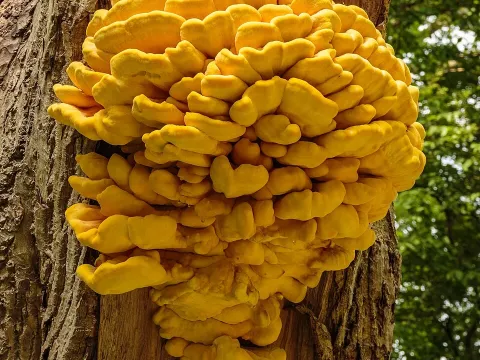
Sulphur polypore
Laetiporus
The causal agent of this disease is the fungus Laetiporus sulphureus, a basidiomycete that acts as a heartwood rot parasite on various tree species.
What the section contains
Sulphur polypore
The fungus invades the tree through bark wounds, pruning cuts, or frost cracks, where its mycelium begins to colonize the woody tissue.
It secretes enzymes that decompose cellulose and lignin, transforming the solid heartwood into a brownish, crumbling mass known as brown rot.
Large, bracket-like, bright yellow-to-orange fruiting bodies emerge on the exterior of the trunk, signaling advanced internal infection.
The fungus continues to digest the wood even after the tree dies, making it a persistent and aggressive decomposer in forest and orchard environments.
Distinctive sulfur-yellow to orange fan-shaped fruiting bodies appearing in overlapping clusters on the trunk are the primary sign.
Affected trees often show signs of crown dieback, reduced vigor, and yellowing foliage as the internal rot disrupts water conduction.
When the trunk is probed or damaged, the wood often breaks into characteristic brown, brittle, cube-shaped pieces.
Deep hollows may form in the trunk where the fungus has completely digested the inner wood, leading to structural instability.
Bark peeling or splitting around the base of the tree often reveals the presence of white mycelial mats beneath the surface.
Warm, humid conditions are ideal for the rapid growth of the fungus and the production of its visible fruiting bodies during late spring and summer.
Older trees with long-standing wounds or poor vitality are significantly more susceptible to infection by this pathogen.
Poor orchard management, such as leaving large stubs after pruning, provides easy entry points for airborne spores to land and germinate.
High moisture levels in the soil or standing water near the base of the tree can weaken bark defenses, facilitating fungal penetration.
The fungus is opportunistic and can persist in debris, soil, or decaying wood nearby, waiting for a suitable host to infect.
The main danger is the extensive internal decay of the heartwood, which compromises the tree's structural integrity and increases the risk of collapse.
It poses a significant threat to fruit trees and valuable timber, leading to reduced life expectancy and total loss of affected specimens.
As a pathogen that decays the root flare and main stem, it turns trees into potential hazards to nearby structures and people.
- Destruction of internal wood structure.
- Increased risk of sudden tree failure.
- Decreased fruit production and tree health.
Because there is no effective systemic treatment for internal wood rot, the infection is generally considered irreversible in orchard settings.
The most effective management strategy is the removal of severely infected trees to eliminate the source of spores in the immediate area.
Proper pruning techniques, including avoiding large branch stubs and ensuring clean cuts, help prevent the fungus from entering the tree.
Wounds should be promptly treated with protective sealants or fungicides to prevent colonization by fungal spores during wet weather.
Sanitizing pruning tools with bleach or alcohol between different trees is crucial to prevent mechanical transmission of the pathogen.
Maintaining tree vigor through balanced fertilization and adequate irrigation helps the tree develop its own natural defense mechanisms.