
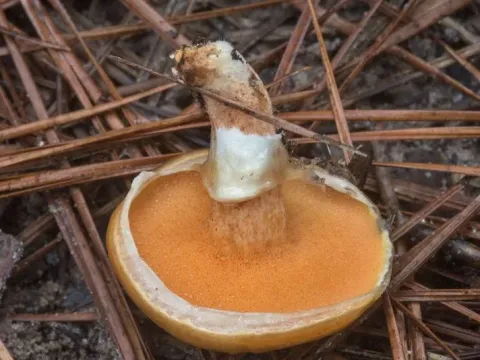
Suillus cothurnatus
Suillus cothurnatus
Suillus cothurnatus is not a plant pathogen or a disease agent, but rather a beneficial mycorrhizal fungus that forms symbiotic relationships with trees.
What the section contains
Suillus cothurnatus
This fungus belongs to the Suillaceae family and is commonly found in association with various species of pine (Pinus spp.).
The fungus colonizes the root system of the host plant, forming a symbiotic association known as ectomycorrhiza.
This biological interaction helps the host tree by increasing the absorption surface of roots, facilitating the uptake of water and vital minerals.
Because it provides essential nutrients to the plant, it is considered an essential component of forest health rather than a source of infection.
The growth and distribution of Suillus cothurnatus are dictated by the presence of suitable hosts and specific environmental parameters.
It thrives in temperate forests where sandy or acidic soils provide the necessary drainage for mycelial development.
High levels of soil moisture and moderate temperatures trigger the formation of fruiting bodies, typically during late summer and autumn.
The fungus relies on spore dispersal to colonize new areas, often aided by environmental factors such as wind or forest-dwelling animals.
Mycorrhizal colonization is most successful in ecosystems where the soil is rich in organic matter and free from high concentrations of synthetic fertilizers.
Suillus cothurnatus causes no harm to the host plant and does not cause any form of plant disease or structural damage.
There is no evidence of the fungus feeding on live tissue, as it is strictly a mutualistic partner that exchanges nutrients for carbon.
In forest management, its presence is often encouraged to boost the growth rates and stress tolerance of pine plantations.
The fungus does not produce toxins or enzymes that degrade the structural integrity of healthy root systems or tree trunks.
Its role is exclusively focused on supporting the plant's metabolic processes rather than interfering with its vital functions.
Control measures are unnecessary for Suillus cothurnatus because it is not a pest or a disease, but a helpful biological assistant.
Application of fungicides or other chemical treatments is strongly discouraged, as they may disrupt the beneficial fungal network in the soil.
Management practices in nurseries or forests should focus on maintaining healthy soil conditions to foster natural mycorrhizal associations.
If physical removal of mushrooms is required for aesthetic reasons, simple manual collection of the fruiting bodies is sufficient.
No specific intervention is required, as the fungus is part of the natural and healthy biological cycle of pine-dominated landscapes.