
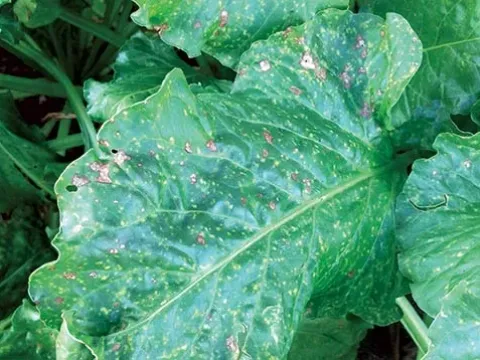
Stemphylium leaf spot of beet
Stemphylium beticola
The causative agent of the disease is the fungus Stemphylium beticola, which belongs to the Ascomycota phylum (anamorphic state). This pathogen primarily acts as a facultative parasite, capable of surviving on crop residues as a saprotroph before infecting healthy host plants.
What the section contains
Stemphylium leaf spot of beet
The fungus survives the winter as mycelium or conidia in the soil or on infected plant debris. During the growing season, conidia are dispersed by wind, rain splashes, and insects to healthy foliage, initiating new infection cycles.
Upon landing on a leaf, the conidia germinate, and the mycelium penetrates the leaf tissue through stomata or directly through the cuticle, especially where microscopic damage is present. The fungal hyphae then proliferate, causing cellular death.
The pathogen is highly dependent on environmental conditions for sporulation. It produces dark-colored conidiophores and conidia that are distinct under a microscope, allowing for quick identification of the agent.
Although it is known to infect several species, Stemphylium beticola is recognized as a significant disease of sugar beet and related Beta species, capable of causing localized outbreaks under conducive conditions.
The first symptoms appear on the older, lower leaves as small, brown, circular to oval lesions. As the infection progresses, these spots often expand and exhibit a characteristic concentric zonation, which is a hallmark of the fungus.
The center of the lesion typically turns tan or greyish-white, while the edges remain dark brown. Under high humidity, an olive-black velvety layer of spores (conidia) develops on the surface of the lesions.
When the infection is severe, the lesions coalesce, covering large sections of the leaf blade. This leads to the yellowing and necrosis of the entire leaf, eventually causing it to dry out and collapse.
The affected leaf tissue often becomes brittle and may tear, resulting in a ragged appearance. This progression usually moves from the bottom of the plant upwards through the canopy.
- Circular brown lesions
- Concentric ring patterns
- Olive-black sporulation
- Leaf necrosis and premature drop
Development of Stemphylium leaf spot is highly favored by periods of high humidity, frequent rainfall, or heavy dew. The disease spreads most rapidly when temperatures range between 20°C and 25°C.
Densely planted crops that lack sufficient airflow provide the ideal microclimate for the fungus. The retained moisture within the dense foliage protects the spores from desiccation, allowing them to infect host tissues effectively.
Plants under physiological stress, such as those suffering from nitrogen deficiency or those attacked by insect pests, show higher susceptibility to infection compared to healthy, vigorous plants.
Cloudy weather with intermittent drizzles creates persistent moisture on leaf surfaces, which is critical for the germination of fungal conidia. Even a brief period of leaf wetness can be sufficient for infection to occur.
Poor agricultural practices, such as failing to rotate crops, ensure that the fungal inoculum remains abundant in the field, increasing the likelihood of an epidemic during the season.
The economic impact of the disease is primarily caused by the reduction in the plant's photosynthetic capacity. As the leaves wither, the plant's ability to accumulate sugar in the root is significantly impaired.
Premature leaf loss forces the sugar beet to redirect stored nutrients from the root to regenerate foliage, which directly reduces the yield and the sugar content of the harvested crop.
In addition to yield loss, severe infection makes the crop more vulnerable to secondary pathogens, including storage rots, which decrease the longevity and market quality of the beetroots.
For seed production, the infection of seed stalks leads to reduced seed quality, including lower germination rates and poor seed weight, which threatens the profitability of the next growing cycle.
Control costs also rise significantly when prophylactic and reactive fungicide applications are required to manage the spread of the disease across large-scale commercial fields.
Crop rotation is the most effective cultural practice; avoiding the planting of beets in the same field for at least 3-4 years helps break the life cycle of the pathogen.
Deep plowing or incorporating crop residues into the soil accelerates the decomposition of plant debris, thereby reducing the amount of overwintering inoculum present for the next season.
Maintaining optimal soil fertility, particularly providing adequate potassium, improves the plant's natural resistance to fungal infections and helps maintain overall vigor.
Effective pest management is crucial, as controlling insects that damage leaf tissue reduces the number of entry points available for the fungal spores to initiate an infection.
When environmental conditions favor the disease, the use of registered systemic fungicides, such as triazoles or strobilurins, can effectively mitigate the impact of the disease if applied early.