
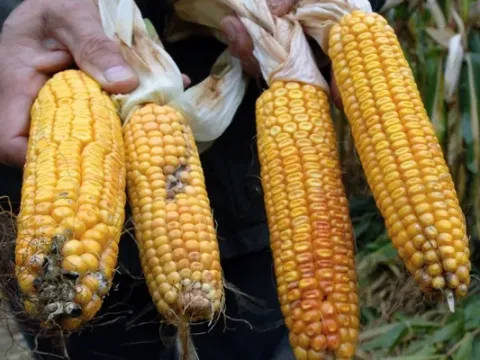
Stenocarpella ear rot
Stenocarpella macrospora
The causative agent of this disease is the fungus Stenocarpella macrospora (formerly known as Diplodia macrospora). It is a significant pathogen that primarily targets maize crops in regions with warm and humid climates.
What the section contains
Stenocarpella ear rot
The fungus survives the winter primarily on infested corn residue, persisting as mycelium and pycnidia. This makes crop debris the primary reservoir for the disease in subsequent growing seasons.
During the growing season, the fungus produces spores that are spread by wind and rain splashes. These spores land on susceptible plant parts such as leaves, stalks, and ears, initiating the infection cycle.
The infection process involves the germination of conidia, followed by the penetration of the plant tissue through stomata or wounds caused by insects or mechanical damage.
Microscopically, the fungus is characterized by the production of large black pycnidia that erupt through the epidermis of the host tissue, releasing spores to perpetuate the life cycle.
Initial leaf symptoms manifest as small chlorotic spots that rapidly enlarge, developing into elongated, oval, or irregular lesions with a brown color.
As the infection progresses, the lesions typically exhibit a lighter center with a darker border, often surrounded by a chlorotic halo caused by fungal toxins affecting the leaf tissue.
Stalk infection frequently occurs at the nodes, where tissues become soft and discolored. This loss of structural integrity often leads to lodging, as the stalks can no longer support the weight of the plant.
When the ears are infected, a dense white or grayish mycelial mat develops between the kernels, often causing the ear to become light, chaffy, and decayed.
A definitive sign of the late stage of the disease is the appearance of numerous minute black pycnidia on the surface of the infected leaves or husks, visible to the naked eye.
High humidity and frequent rainfall are the most critical environmental factors that promote the development and spread of Stenocarpella macrospora.
The fungus thrives at temperatures ranging from +20°C to +30°C. These conditions facilitate rapid mycelial growth and spore production, potentially leading to widespread outbreaks.
Continuous corn cropping practices significantly increase the risk of disease, as they allow the pathogen to accumulate in the soil and on crop debris from previous harvests.
Dense planting patterns that restrict air movement increase the humidity within the crop canopy, creating an ideal microclimate for fungal infection and spore germination.
Insect activity, particularly that of borers, plays a crucial role in disease dissemination by creating physical entry points for the fungus into the plant's vascular system.
The primary economic impact of the disease is a significant reduction in grain yield, coupled with a decrease in grain quality and marketability.
Severe leaf infection leads to premature tissue necrosis, which limits photosynthesis, resulting in poor grain filling and the development of underweight, shriveled ears.
Stalk rot often results in premature lodging, which complicates mechanical harvesting and leads to substantial field losses of the mature crop.
Infected kernels are generally non-viable, making them unsuitable for use as seed, which necessitates the procurement of fresh, pathogen-free seed stock.
Furthermore, infected corn may contain mycotoxins, which can be harmful if consumed by livestock, thus impacting the economic value and utility of the harvested grain.
Crop rotation is the most fundamental management strategy. Rotating maize with non-host crops for at least 3–4 years effectively reduces the inoculum level in the field.
Thorough tillage practices that bury crop residues help to accelerate decomposition and destroy the primary sources of fungal inoculum, reducing the risk of early-season infection.
Selecting resistant or tolerant hybrids is an essential component of an integrated disease management program, providing consistent protection throughout the growing season.
Seed treatment with high-quality fungicides offers protection to seedlings during germination and early development, ensuring a healthy plant stand.
In cases of severe disease pressure, the application of foliar fungicides during critical growth stages can effectively suppress the disease and protect the yield potential of the crop.