
Stenocarpella ear rot
Stenocarpella
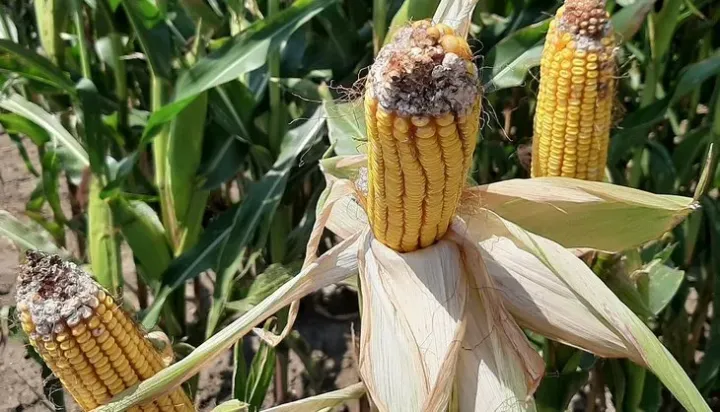
Description
Symptoms
The first visual signs of the disease appear on the husks of the ears as rapidly expanding grayish or whitish lesions. Gradually, the fungal mycelium penetrates deeper, eventually covering the entire ear and causing premature wilting.
A dense, white fungal growth often forms on the surface of infected ears, eventually turning grayish-brown. Inside the ear, abundant mycelium can be observed between the rows of kernels, completely invading the ear structure.
Infected kernels become brittle, dull, and crumble easily under pressure. In later stages, tiny black dots — the pycnidia of the fungus — become clearly visible on the husks and the cob shank.
When the stalk is infected at the base, it leads to tissue darkening, loss of structural strength, and internal rot. This often results in lodging, which makes the plants vulnerable to breakage and secondary infections.
In the field, infected ears may remain in an upright position but appear stunted compared to healthy plants, and the grain often emits a distinct musty or moldy odor.
Pathogen
The causal agent of this disease is the fungus Stenocarpella maydis (formerly known as Diplodia maydis). It is a highly pathogenic organism that affects corn crops across various global agricultural regions.
The life cycle of the pathogen is closely tied to crop residues, where the fungus can survive for several years. It persists in the soil as pycnidia and mycelium, waiting for favorable environmental conditions to initiate infection.
During the growing season, the infection spreads via conidia, which are disseminated by wind or splashing rain. The fungus typically enters plant tissues through wounds, insect-damaged areas, or natural openings in the ear and stalk.
The biology of the pathogen is characterized by high aggressiveness in high-moisture environments. The fungus produces specific toxins that degrade host cell walls, facilitating the rapid colonization of plant tissues by its mycelium.
It is crucial to note that Stenocarpella maydis can infect the plant at various developmental stages, though the most significant damage occurs when infection strikes the ears during the milk to dough stages of grain development.
Conditions for development
The primary factor triggering disease development is high humidity and frequent rainfall, combined with moderately warm temperatures during the latter half of the growing season.
The most active infection of ears occurs when heavy rains fall in late summer, at a time when the ears are not yet fully mature but are highly susceptible to fungal spores.
Large quantities of infected plant debris left on the soil surface significantly increase the inoculum load. Minimal tillage practices often contribute to a higher accumulation of the pathogen in the field.
High plant populations and excessive nitrogen fertilization, which can reduce stalk integrity, create a microclimate conducive to spore germination and rapid fungal spread.
Additionally, physical damage caused by insect pests, such as the European corn borer, creates entry points that allow the fungus to bypass the plant's natural defenses.
Why it matters
Stenocarpella ear rot causes significant economic losses by reducing both grain weight and overall quality. Infected ears are largely unsuitable for long-term storage or processing.
The major danger lies in the accumulation of mycotoxins produced by the fungus, which render the grain toxic to livestock and humans, making it unfit for feed or food applications.
The disease drastically reduces seed germination energy and overall vigor. Using seed material from infested fields is strictly prohibited without rigorous laboratory testing and proper chemical treatment.
During severe outbreaks, yield losses in specific areas can reach 30–50% or more, making corn production in highly infested regions economically unfeasible.
Stalk infection leads to widespread lodging, which significantly complicates harvesting operations, results in higher grain losses in the field, and increases equipment wear.
Protection
Effective management begins with strict crop rotation, avoiding the continuous planting of corn on the same field for several consecutive years.
Deep plowing of crop residues is a mandatory practice that accelerates decomposition and prevents fungal spores from reaching the soil surface.
It is essential to use hybrids that possess genetic resistance to ear rot. Breeding for resistance to Stenocarpella remains the most reliable long-term control method.
Treating seeds with high-quality fungicides before planting protects emerging seedlings from early-season infection and supports uniform crop development.
- Implementation of integrated pest management (IPM) to control insect vectors.
- Maintaining optimal planting densities according to agronomical recommendations.
- Harvesting as soon as the crop reaches physiological maturity to limit exposure.
- Balanced nutrient management, particularly ensuring adequate potassium levels.
Discussion
No discussions yet — be the first.